
What Is the Best Frequency for Meditation? A Guide to Finding the Sound That Supports Your Practice
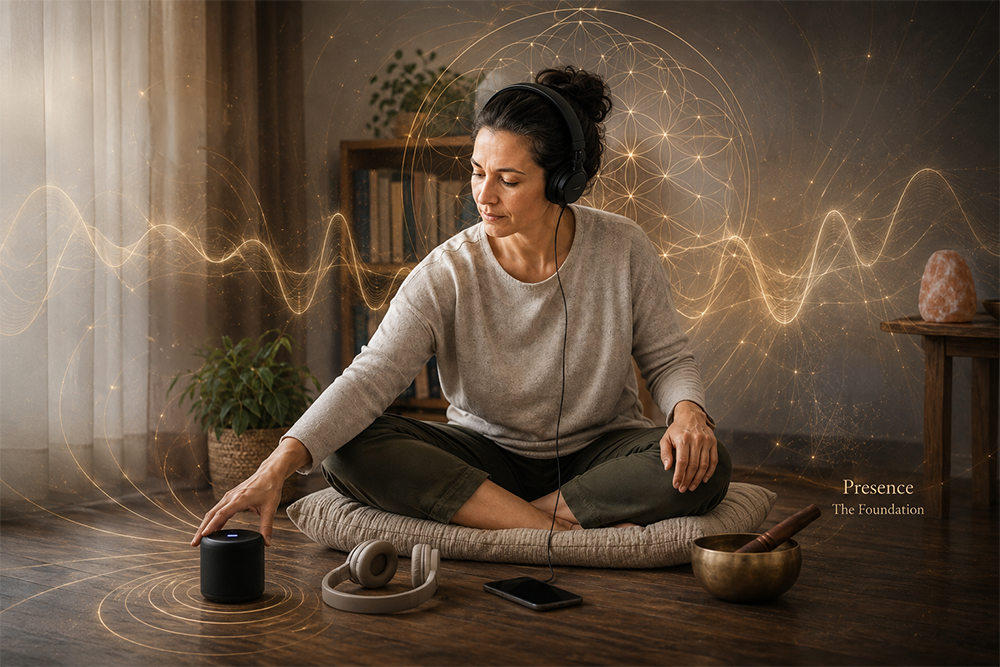
What is the best frequency for meditation? Explore 432 Hz, 528 Hz, binaural beats, and other sounds while discovering how different frequencies can support different meditation experiences.
So, What Is the Best Frequency for Meditation?
There is no scientifically established frequency that is universally best for meditation. Perhaps this is not a question science has discovered one final answer for but a question each of us discovers through our own experience.
Different sounds can support different experiences. A meditation track may help you settle after a busy day. A gentle pulse may give your attention somewhere to rest. A familiar sound may become part of a ritual that tells your mind and body, this is the time to become still.
You do not have to find the perfect number before you begin. You can listen. You can notice. And over time, you may discover which sounds invite you to return.
Before Choosing a Frequency, Notice What You Want the Sound to Do
After a full day, perhaps you want something warm and spacious. During a focused practice, you might prefer something simple and repeating. At another moment, the quiet movement of wind, birds, or rain may be enough.
Meditation can ask different things of our attention.
In focused-attention practice, a steady sound may give the mind a place to return. During open awareness, the sounds already around you may become part of the meditation itself. A mantra or prayer may feel most natural when the pitch supports the voice. A guided meditation asks for something simpler: a sound you can comfortably hear and follow.
So the sound can be chosen in relationship to the practice.
What would you like the sound to support? That question can be more useful than searching for a universal answer.
What Does “Meditation Frequency” Actually Mean?
The word frequency can describe several different things in meditation audio.
- Audible Frequency: Describes the pitch of a sound. A 528 Hz tone, for example, means the sound wave cycles 528 times per second.
- Tuning Reference: When music is described as 432 Hz, it usually refers to a tuning system in which A is set to 432 Hz rather than the more common 440 Hz reference. The entire musical tuning is shifted slightly lower.
- Binaural Beats: Uses two different tones, one delivered to each ear. If one ear receives 200 Hz and the other receives 210 Hz, the listener perceives a rhythmic difference of 10 Hz.
- Brainwave States: Terms such as alpha, theta, delta, beta, and gamma refer to ranges of electrical activity measured in the brain.
The numbers may look similar, but they describe different things. A 10 Hz binaural beat is not the same thing as 10 Hz brain activity.
Understanding that distinction simply helps you know what you are actually listening to.
What Is Special About 432 Hz?
432 Hz has become one of the most familiar tuning references in meditation and wellness music.
Music tuned with A = 432 Hz is slightly lower in pitch than music tuned with A = 440 Hz. Some listeners experience the difference as warmer, softer, or more comfortable. Others notice very little difference.
Research into 432 Hz has explored subjective experience and selected physiological measures, with some studies suggesting interesting differences in areas such as relaxation, mood, and physiological response. That does not make the experience less meaningful.
A sound you genuinely enjoy may become easier to return to. Over time, the sound itself can become part of a ritual: the beginning of a quiet evening, a few minutes of inward attention, a familiar doorway into stillness.
Sometimes the value of a sound begins with something wonderfully simple.
You like listening to it.
What About 528 Hz?
528 Hz is often associated with the modern Solfeggio frequency tradition and with symbolic ideas of transformation, love, restoration, and renewal.
For many people, those associations are part of the experience.
A frequency may become connected to an intention, a memory, a ritual, or a season of personal growth. In that context, the sound is not only something you hear. It becomes part of the meaning you bring to your practice.
With the technology and evidence currently available, science has not been able to establish that 528 Hz has a unique ability to repair DNA, treat anxiety, or reliably produce one particular physiological outcome for every person.
The two perspectives do not need to compete. Symbolism and personal experience can enrich an experience without becoming a scientific claim. That leaves plenty of room for wonder.
What About Binaural Beats?
Binaural beats offer a different kind of listening experience.
Two slightly different tones are presented separately to each ear, and the difference between them creates the perception of a rhythmic beat. Because the ears need separate signals, stereo headphones are generally used.
Research into binaural beats has explored areas including attention, anxiety, sleep, mood, and pain, with findings varying across studies.
But perhaps the most useful question is experiential.
What happens when you listen? Does the pulse give your attention somewhere to settle? Does it blend comfortably into the meditation? Does it become distracting? Does it help you stay with the breath?
There is something beautiful about allowing the experience to answer for itself.
432 Hz, 528 Hz, or Binaural Beats?
These sounds do not need to compete.
- 432 Hz generally describes a tuning reference.
- 528 Hz describes an audible frequency often accompanied by symbolic meaning.
- Binaural beats use two tones to create the perception of a rhythmic difference.
They are simply different ways of working with sound.
You might choose one because you enjoy its character. Another might fit a particular ritual or intention. A binaural track might support one kind of practice while a singing bowl, guided meditation, nature recording, or silence feels better on another day.
The practice is larger than the number.
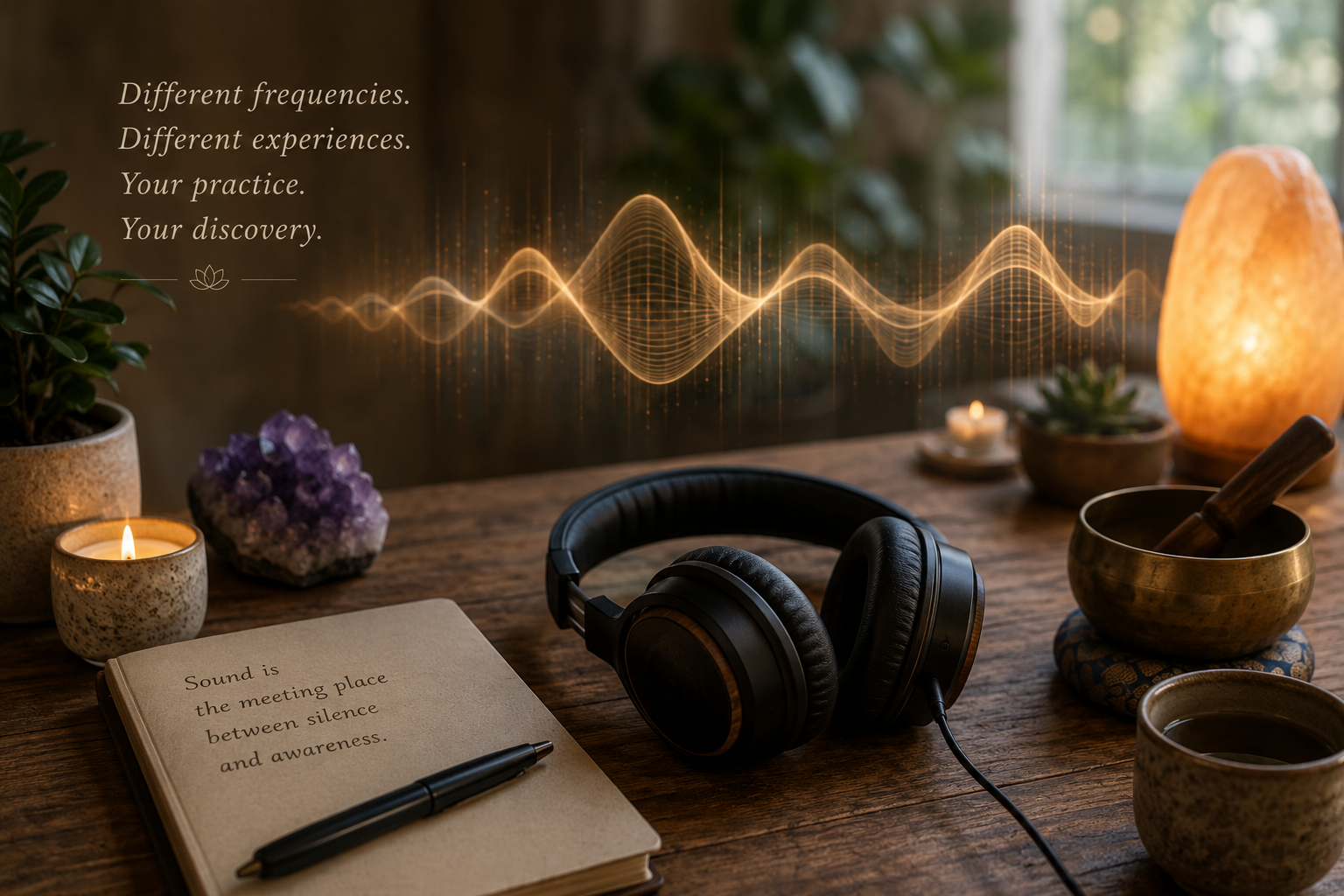
Different frequencies. Different experiences. Your practice. Your discovery.
Discover What Supports You
Rather than searching endlessly for the perfect frequency, let listening become a small practice of awareness.
- Choose two or three different meditation experiences and spend a few minutes with each on different days. Keep the rest of the practice reasonably familiar.
- Notice how you feel before you begin.
- Notice what happens while you listen.
And afterward, ask:
- Did the sound support my attention?
- Did I feel more willing to remain with the practice?
- Would I return to this sound again?
You are not trying to prove that one frequency works for everyone. You are discovering what supports you.
That is a different kind of knowledge, and perhaps a more useful one for a living meditation practice.
Listening Is Part of the Practice
There is something quietly beautiful about searching for a sound that feels like it belongs to your practice.
You may discover it in a familiar frequency, the resonance of a bowl, a gentle pulse, the sound of rain, or somewhere you were not expecting—perhaps in a sound you have heard a hundred times before.
Maybe the question is not about finding the one perfect frequency. Maybe it is about becoming curious enough to listen until something feels like a doorway.
There is much more to explore here: the traditions behind these frequencies, the science of binaural beats, the mathematics of tuning, and the many ways sound can shape a meditation experience. We will explore these subjects more deeply in the articles to come, revealing a larger picture over time.
For now, the invitation is much simpler: Try them. Listen closely. Notice what supports you.
Sound is the meeting place between silence and awareness.
Sources
- Jajoo et al. — “Music Tuned to 440 Hz Versus 432 Hz and the Health Effects: A Double-blind Cross-over Pilot Study.”
- “Music Tuned to 432 Hz Versus 443 Hz: Effects on Cardiovascular and Psychological Parameters.”
- “Binaural beats to entrain the brain? A systematic review of the effects of binaural beat stimulation on brain oscillatory activity.”
- “The Effects of Music and Auditory Stimulation on Autonomic Arousal, Cognition and Attention: A Systematic Review.”
The Sacred Sound Vault holds the frequency sessions behind these notes.
Start 7-Day Free Trial