
What Is 40 Hz? Why Scientists Keep Coming Back to This Frequency
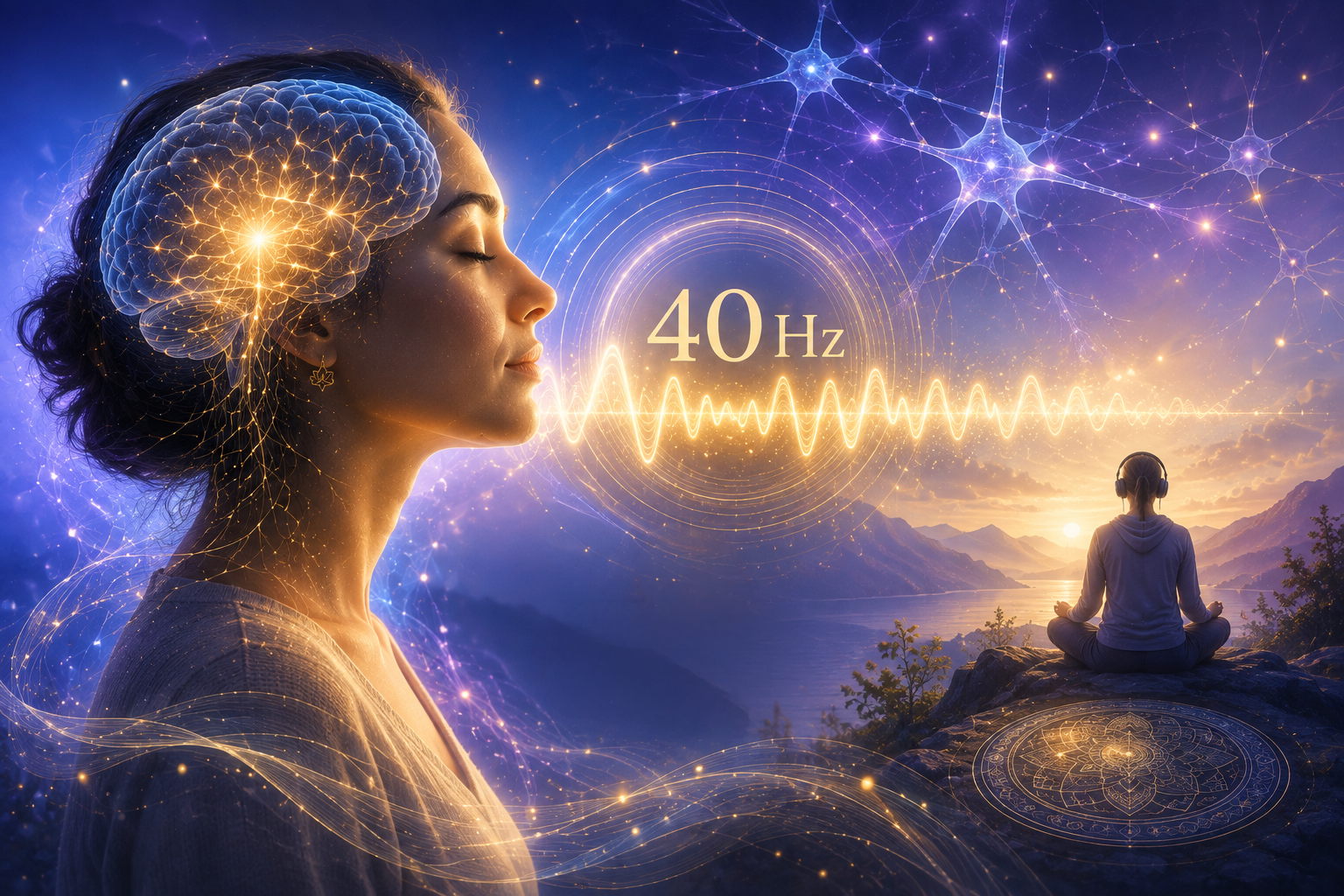
A rhythm repeating 40 times each second has captured the attention of neuroscientists for an unexpected reason: our brains produce gamma activity in this range too. From long-term meditators to sound, light, and vibration, discover why scientists keep returning to 40 Hz—and what this curious rhythm might reveal about the meeting place between sound and the brain.
Imagine closing your eyes and hearing a pulse moving steadily beneath the music.
Not a melody. Not something you need to follow.
Just a rhythm repeating 40 times every second.
You may barely notice it. But your brain does.
That simple interaction—between a rhythm outside the body and electrical activity inside it—is one reason 40 Hz has become such an intriguing frequency in neuroscience.
And the story gets stranger from there.
Because some of the research that brought gamma activity into the spotlight didn't begin with sound at all.
It began with monks.
The Rhythm Already Inside Your Brain
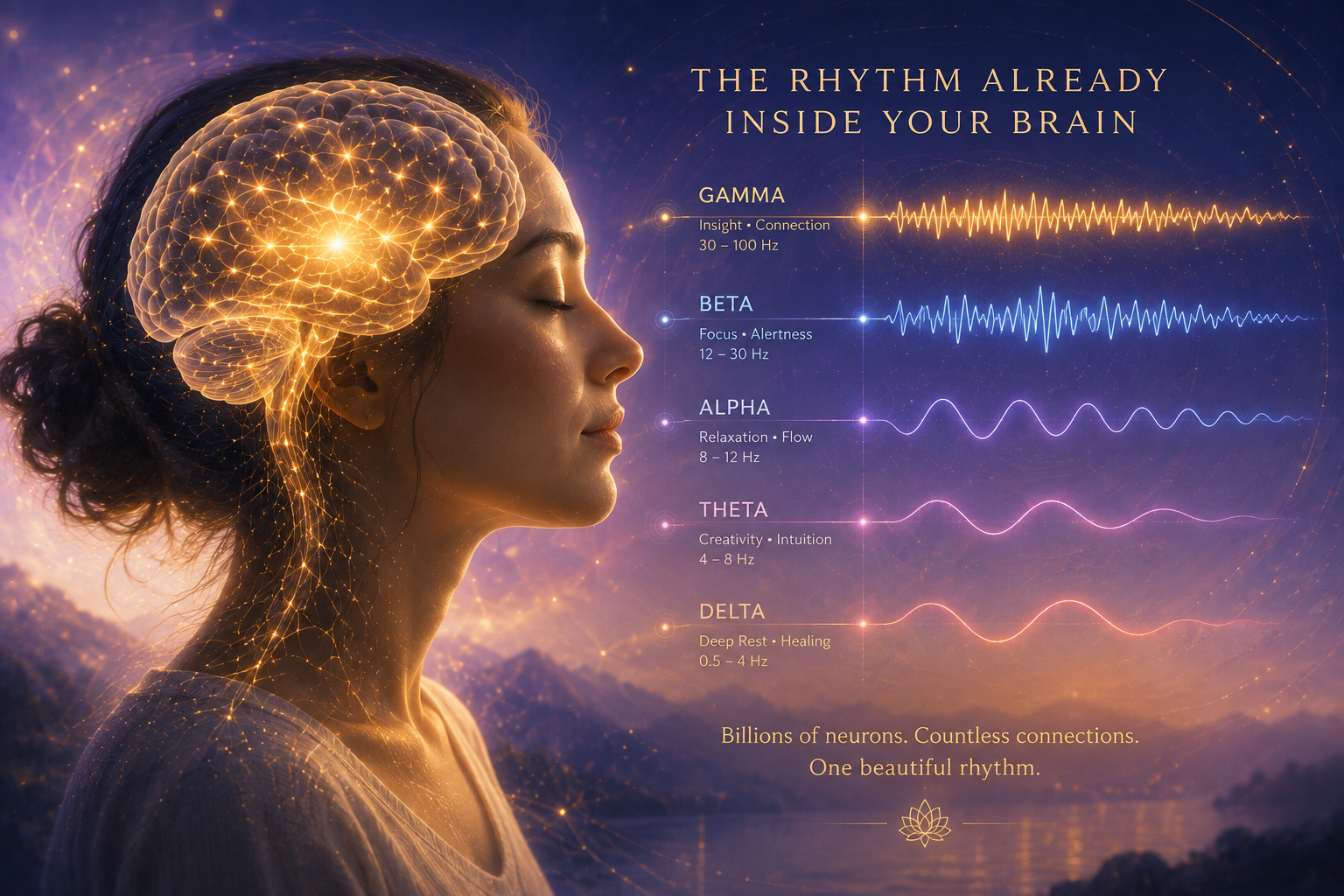
Your brain is never electrically still. Billions of neurons are continually communicating, creating patterns researchers can observe with an EEG.
Some of those patterns are grouped into familiar brainwave ranges: delta, theta, alpha, beta, and gamma. Forty hertz sits within gamma, one of the faster ranges of brain activity, associated in research with attention, perception, memory, and communication across different areas of the brain.
But gamma became especially compelling when scientists began looking at what happens during deep meditation.
In the early 2000s, neuroscientist Richard Davidson and colleagues studied highly experienced Tibetan Buddhist practitioners as part of a broader scientific dialogue with the Dalai Lama about meditation and the mind. Some of these practitioners had accumulated 10,000 to 50,000 hours of meditation practice.
EEG sensors recorded their brains as they entered a meditation centered on unconditional loving-kindness and compassion.
Their gamma activity was remarkable.
The experienced meditators showed unusually strong gamma activity and synchronization compared with inexperienced controls. Differences could even be seen before the meditation began.
Here is the part that often gets lost when this study is discussed online:
Nobody was playing 40 Hz to the monks.
Their brains were producing these patterns during meditation.
That distinction matters. Tibetan Buddhist traditions weren't secretly teaching a "40 Hz frequency." Long before EEG machines existed, contemplative traditions were exploring attention, compassion, awareness, and experiences of interconnectedness.
Modern neuroscience arrived much later—and discovered something measurable happening alongside those practices.
Perhaps that is more extraordinary than trying to turn an ancient tradition into a frequency claim.

Then Scientists Brought the Rhythm From the Outside In
Now imagine something different.
Instead of observing a rhythm the brain produces, researchers play a precisely repeating sound.
The ear receives it. The auditory system responds. And under certain conditions, scientists can measure electrical activity in the brain corresponding to that repeating rhythm.
This is known as an auditory steady-state response, or ASSR. Responses around 40 Hz have received particular attention because they can produce strong, measurable responses in EEG and MEG experiments.
That doesn't mean a 40 Hz recording simply switches your entire brain into "gamma mode."
Think of it more like two rhythms meeting.
One arrives from the outside.
One belongs to the living brain.
Researchers became interested in what happens at that meeting point.
And soon they weren't only using sound.
What If You Could See—or Feel—40 Hz?
A rhythm doesn't have to arrive through your ears.
Researchers have explored light flickering 40 times per second, combinations of light and sound, and physical vibration.
Same number.
Completely different sensory experience.
This is an important part of the 40 Hz story because "40 Hz research" can sound as though scientists are all studying the same thing. They aren't.
Hearing a rhythmic sound through headphones isn't equivalent to seeing pulsing light. And neither is the same as feeling vibration moving physically through your body.
One of the more unexpected examples comes from research involving Parkinson's disease.
When 40 Hz Became Something You Could Feel
In one small study, people with Parkinson's disease didn't simply listen to 40 Hz.
They sat in a specially designed chair that delivered 40 Hz low-frequency vibration through the body.
Three times a week for 12 weeks, participants experienced the vibration through areas including the legs, buttocks, and back. Researchers reported improvements in several motor measures in the treatment group, including tremor, rigidity, slowed movement, posture, and gait.
It's a compelling finding and deserves continued research into specialized 40 Hz physioacoustic stimulation for Parkinson’s disease, while everyday headphone listening remains a separate experience.
Other researchers have explored nearby frequencies, including 35 Hz binaural stimulation, as well as combined 40 Hz light and sound in animal research.
And that raises a much bigger possibility:
Maybe the story isn't about finding one perfect number.
Maybe it's about what rhythm can do.
So What Does Listening to 40 Hz Actually Feel Like?
This is where I think the laboratory needs to step aside for a moment.
Put on headphones. Close your eyes. Let a rhythmic sound move through the background of your awareness.
You don't need to search for gamma waves.
You don't need to feel your brain "switch states."
And you certainly don't need to recreate what happened inside the brain of a monk with 30,000 hours of meditation experience.
Simply notice the experience.
For some people, rhythmic audio can feel absorbing or mentally organizing. It can give attention somewhere to rest during meditation or focused work. Others may experience it more subtly—or notice very little at all.
And "40 Hz audio" itself can be created in different ways: a low tone, a sound modulated 40 times per second, repeating pulses, or tones arranged to create a binaural beat.
Same number.
Different ways of meeting it.
The More Interesting Question
Forty hertz began as a measurement.
Follow it into the brain, though, and the story becomes much larger.
We find experienced meditators producing extraordinary gamma patterns. We find the brain responding to rhythms arriving through sound. We find researchers translating that same number into light and physical vibration.
None of this proves that 40 Hz is a mystical frequency, a shortcut to higher consciousness, or a treatment hidden inside a pair of headphones.
But it does reveal something beautiful.
We are rhythmic beings living in a rhythmic world.
A sound can exist outside you as vibration in the air—and moments later, your nervous system is responding to it.
Science is still trying to understand exactly what happens in that exchange.
Perhaps that is the real fascination of 40 Hz.
The frequency is only the invitation.
What happens when we meet it is the deeper story.
Sources & Educational Notes
The key research behind this article includes Lutz et al.'s landmark work examining gamma synchrony in long-term Buddhist meditators, research into the 40 Hz auditory steady-state response, and preliminary investigations of rhythmic sensory and physioacoustic stimulation in Parkinson's disease.
- Lutz et al. — Long-term meditators self-induce high-amplitude gamma synchrony during mental practice (PNAS, 2004)
- 40 Hz physioacoustic stimulation in Parkinson's disease — randomized controlled trial
- Binaural acoustic stimulation in Parkinson's disease
- 40 Hz auditory steady-state response and cognition — systematic review
- 40 Hz auditory and visual stimulation in a Parkinson's disease mouse model
This article is provided for general educational purposes. Research involving 40 Hz sensory and vibratory stimulation is evolving. Bio Alquemie's frequency-based listening experiences are intended for listening, reflection, creativity, ritual, and general wellness. They are not intended to diagnose, treat, cure, or prevent Parkinson's disease or any other medical or neurological condition.
The Sacred Sound Vault holds the frequency sessions behind these notes.
Start 7-Day Free Trial