


What a Frequency Actually Does to a Room
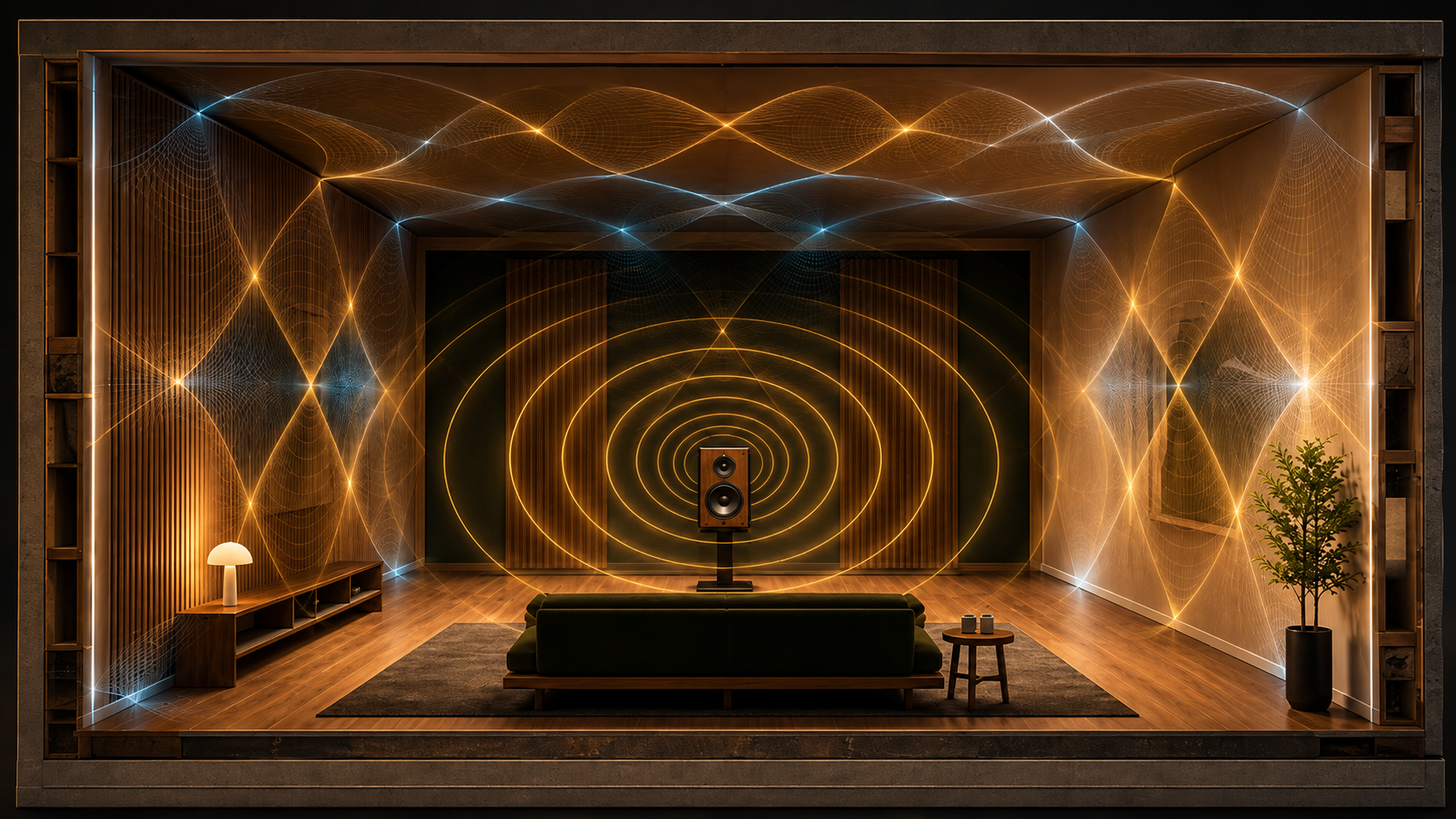
The speaker hasn't moved. The frequency hasn't changed. So why does the sound suddenly feel deeper in one part of the room and almost disappear in another? Step inside the invisible acoustic landscape of a room and discover how wavelength, reflection, furniture, and your own position can change what you hear.
There is an invisible landscape in the room around you.
Sound reveals it.
Play a steady, low bass tone through a speaker at a comfortable volume and begin to walk. Near one wall, the low rumble may become deeper and fuller. A few steps away, it may suddenly thin out. Move toward a corner and the bass may seem to gather there, growing stronger without anyone touching the volume.
Yet the speaker has not changed.
The frequency has not changed.
You changed where you were standing.
This is one of the quiet wonders of room acoustics.
Sound does not simply leave a speaker and travel neatly to your ears. It moves through the room, reaches walls, windows, floors, ceilings, and furniture, then reflects back into the space.
Those reflections meet other sound waves. In some places, they strengthen one another. In others, they partially cancel.
You Are Standing Inside the Wavelength
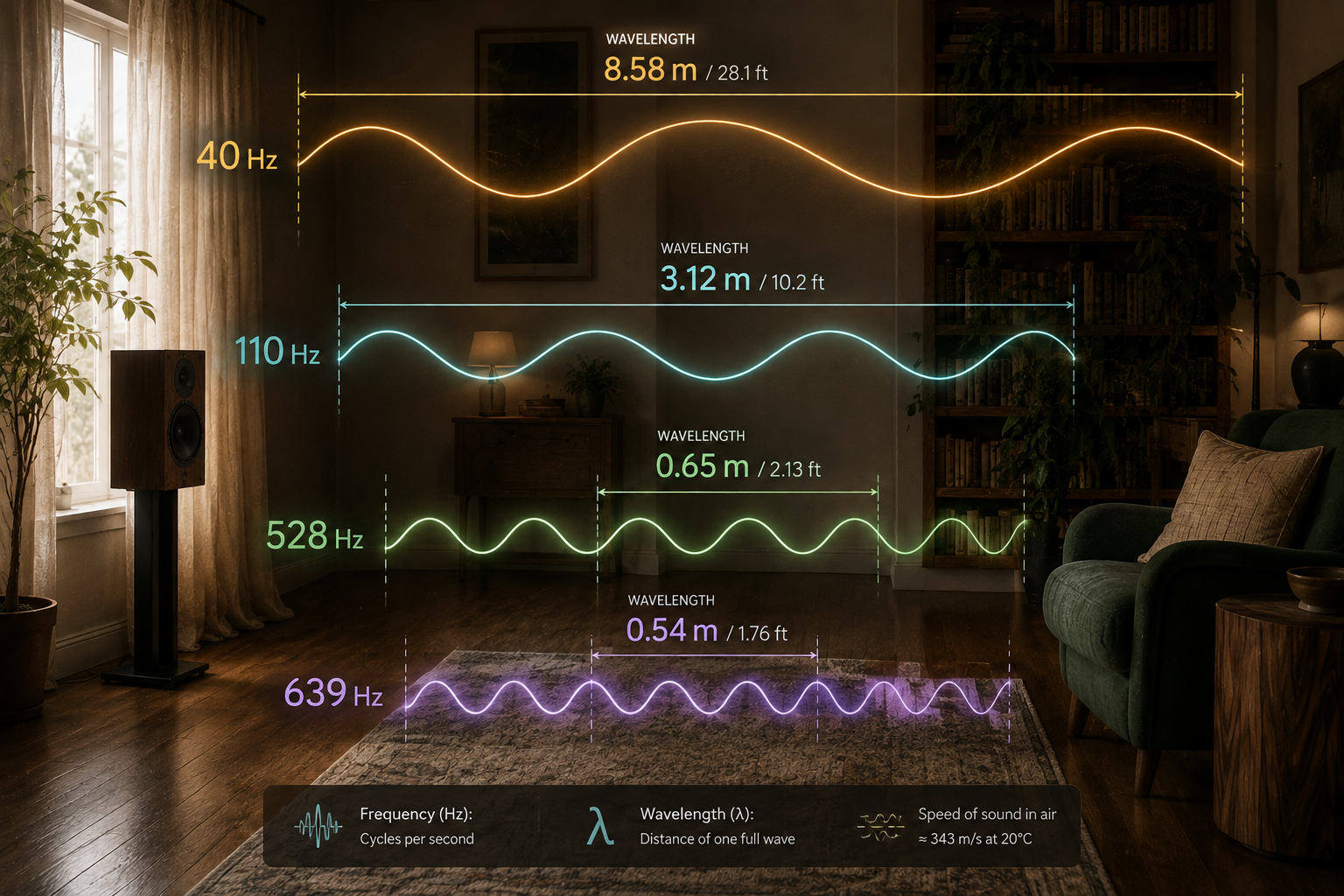
Frequency tells us how quickly a sound wave repeats. It is measured in hertz (Hz), or cycles per second.
Lower frequencies create the deep tones and rumbles we associate with bass.
But frequency also has a physical dimension: wavelength, the distance of one complete wave cycle as sound travels through the air.
At around 68°F (20°C), sound travels at approximately 1,125 feet per second (343 metres per second).
That gives us:
- 40 Hz ≈ 28.1 feet (8.6 metres)
- 110 Hz ≈ 10.2 feet (3.1 metres)
- 528 Hz ≈ 2.13 feet (0.65 metres)
- 639 Hz ≈ 1.76 feet (0.54 metres)
Look again at 40 Hz.
Its wavelength is about 28 feet long.
That may be longer than the room you are sitting in.
A 110 Hz wave stretches roughly 10 feet. At 528 Hz, the wavelength is a little over two feet.
Suddenly, frequency is no longer simply a number on a screen.
You are standing inside its movement.
Why Does Bass Change Around the Room?
Bass is often where a room makes itself known.
Imagine a deep tone moving toward a wall. Some of its energy is absorbed. Some reflects and travels back into the room, where it meets sound that is still arriving from the speaker.
Where those waves reinforce one another, the bass becomes stronger. Where they partially cancel, it becomes weaker.
Acousticians call this interference.
In simple terms, sound waves are meeting and changing what you hear.
You can picture the idea as ripples crossing on the surface of a pond. Where they meet, the movement may grow or diminish. Sound waves are not water waves, but the image gives us a way to imagine something our eyes cannot see.
That is why a bass note can feel full and powerful near one wall, then seem to almost disappear a few steps away.
The speaker did not get louder. You moved through the pattern.
What Are Room Modes?
At certain frequencies, reflected sound can form repeating patterns between the boundaries of a room. These are called standing waves, and the frequencies connected with them are called room modes.
The name sounds technical. The idea is simpler:
The size and shape of a room naturally favor certain bass frequencies.
For example, in a room about 10 feet (3.05 metres) long, the first lengthwise room mode is around 56 Hz.
That means bass near 56 Hz may sound stronger in some places and weaker in others simply because of how that frequency fits within the room.
You do not need to calculate room modes to discover them.
You can hear them.
Discover Your Room’s Acoustic Landscape
Try a simple experiment.
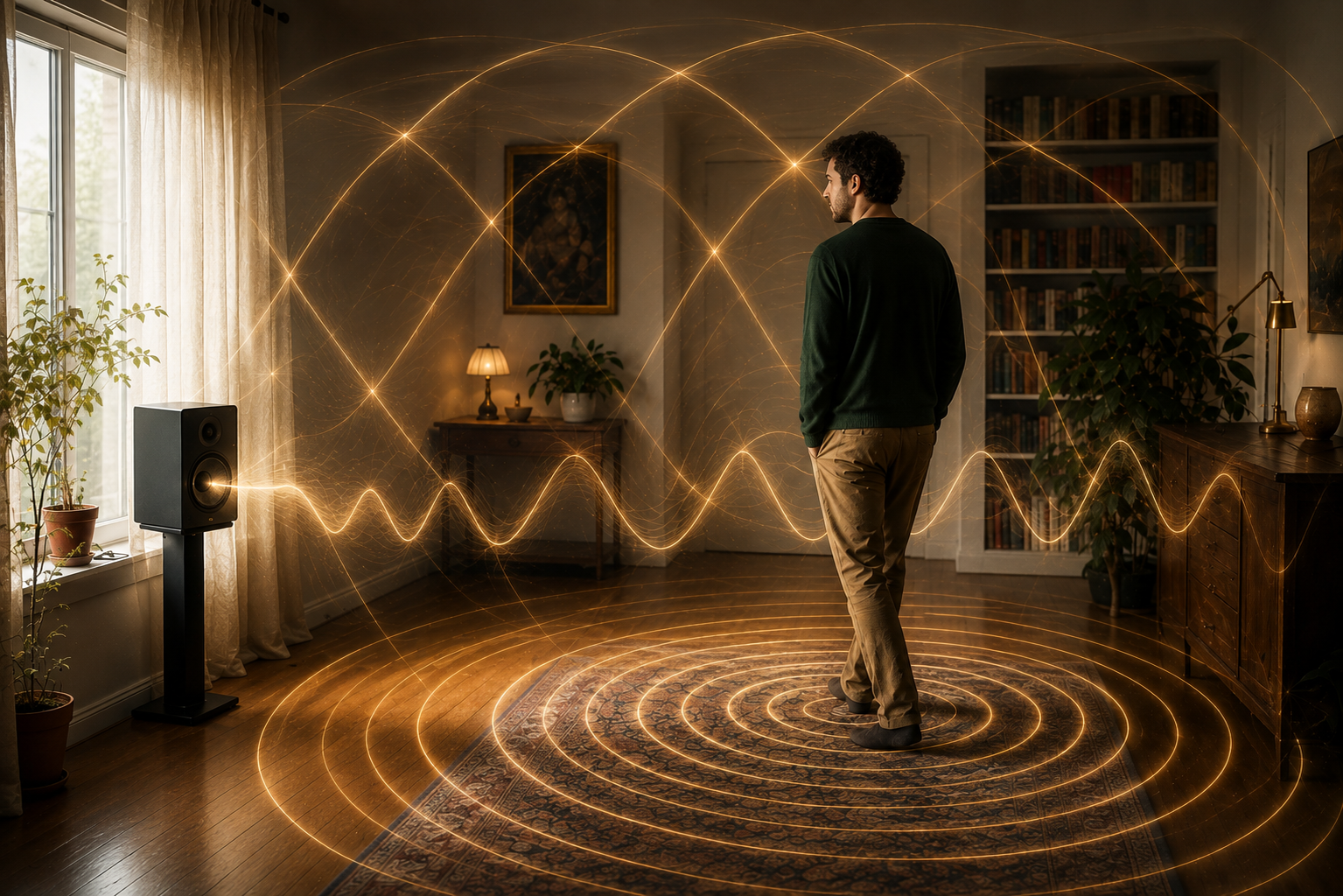
Play a steady low-frequency tone at a comfortable volume. Begin near the center of the room, then slowly walk toward a wall and into a corner.
Notice where the bass becomes fuller. Where does it lose some of its weight? Is there a place where the tone seems to swell, or another where it almost fades?
If you find a spot where the difference is especially noticeable, move backward and forward through it.
Then change one thing. Move the speaker slightly or choose another listening position and listen again.
You may begin to discover your room’s acoustic fingerprint.
What Do Rugs, Curtains, and Furniture Change?
Walk into an empty room and you may hear a bright, hollow echo.
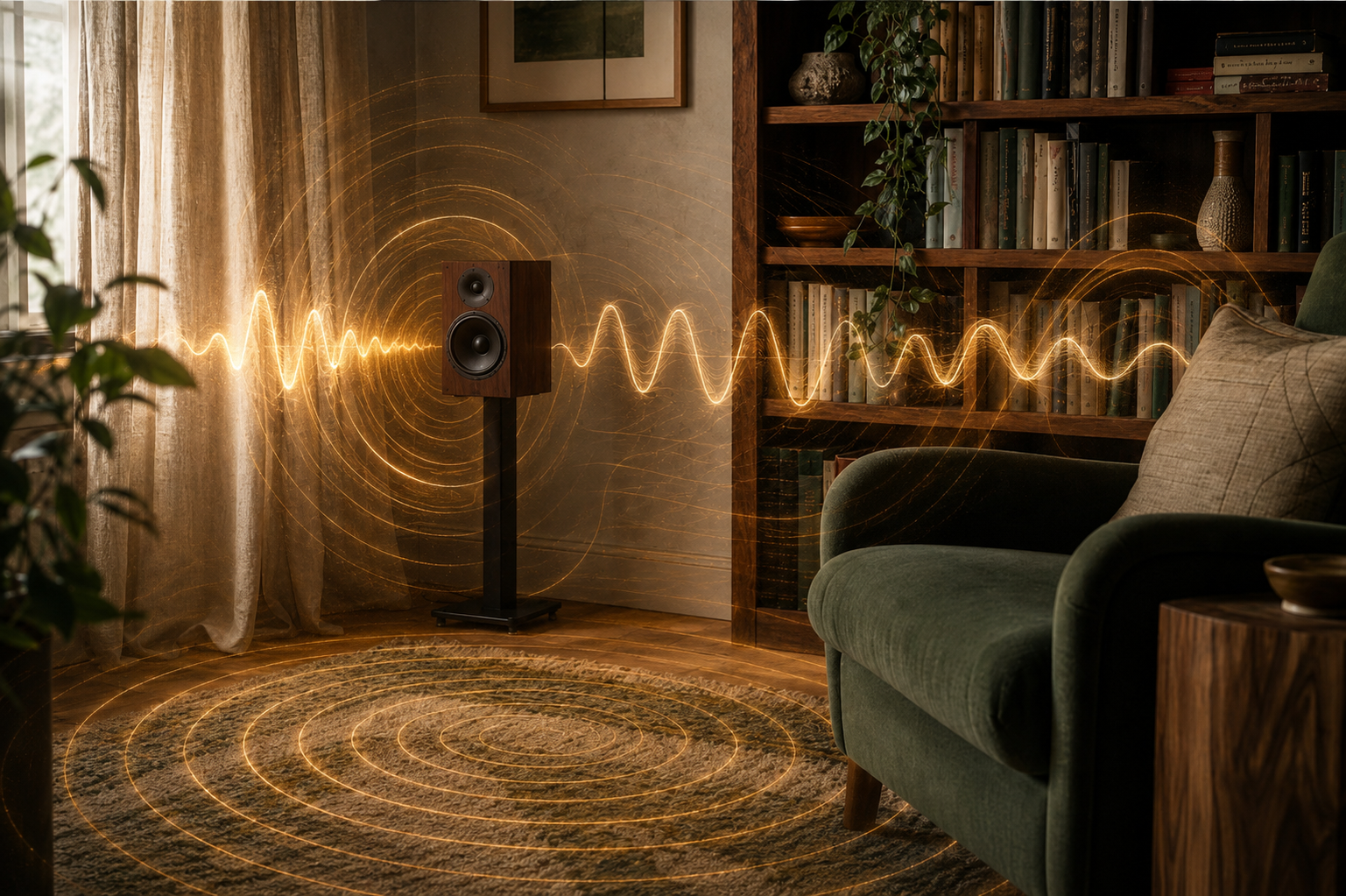
Add rugs, curtains, upholstered furniture, and books, and the room often begins to sound warmer and less reflective.
Different materials absorb and reflect sound differently. Hard surfaces such as glass, tile, and concrete tend to send more sound back into the room, while softer materials can absorb more of it.
But they do not affect every frequency equally.
Deep bass is different. Its long wavelengths can move through a room in ways that a rug or curtain cannot easily tame.
So while softer furnishings may quiet some of the sharper reflections, that low, rumbling bass can still gather in certain places.
Where Measurement Meets Experience
Physics can tell us the wavelength of a tone, how sound reflects, and why room modes form.
Then there is another worthwhile question:
What did you notice while listening?
A sound may feel spacious, intimate, calming, energizing, grounding, or simply interesting.
Those experiences can be meaningful without needing to be the same for everyone.
A 110 Hz tone, for example, has a measurable wavelength of about 10.2 feet (3.1 metres) in room-temperature air. A composition may also be created with the intention of offering a grounding listening experience.
The science describes the sound.
Your experience describes what it was like to hear it.
Both can belong in the same room.
Listen With Care
Exploring sound does not require high volume.
The World Health Organization notes that hearing risk depends on sound level and exposure time. As sound becomes louder, safe listening time becomes shorter.
Keep the volume comfortable, give your ears periods of quiet, and stop if you experience discomfort, ringing, or changes in hearing.
Curiosity does not require intensity.
The Room Is Part of the Sound
The next time music fills a room, move.
Listen from your usual place, then near a wall or in a corner.
The frequency may be the same.
The speaker may be the same.
Yet what reaches you can change because your relationship to the sound has changed.
Every room has an acoustic landscape.
Most of the time, it remains invisible.
Sound gives us a way to discover it.
And perhaps that is the part worth carrying with you:
What reaches us is shaped not only by what was sent, but by the space through which it traveled and the place from which we received it.
Sometimes a few steps are enough to reveal that the world was never quite the same from every point of view.
Sources & Educational Note
This article is intended for general education and distinguishes established principles of acoustics from individual listening experience and creative intention.
Frequency, Wavelength, and the Speed of Sound
- Michigan State University / OpenStax: Speed of Sound, Frequency, and Wavelength
- The Open University: Frequency, Wavelength, and the Speed of Sound
Room Acoustics
- MIT OpenCourseWare: Room Acoustics and Reverberation
- Sound On Sound: Practical Acoustic Treatment
Hearing and Safe Listening
- World Health Organization: Safe Listening
The Sacred Sound Vault holds the frequency sessions behind these notes.
Start 7-Day Free Trial