
Phi: The Golden Ratio and the Code of Consciousness

A sunflower spirals. A fern unfurls. A shell curves inward. Beneath these familiar forms is a number that has fascinated mathematicians, artists, and seekers for centuries: phi. Explore the Golden Ratio, its patterns in nature, and the deeper questions it raises about harmony, growth, and consciousness.
Imagine a sunflower opening toward the morning light, its seeds arranged in sweeping spirals. Or a young fern unfurling from its center, each new curve carrying something of the pattern that came before it.
Somewhere between these living forms and the mathematics we use to describe them is one of the most fascinating numbers we know: phi, or the Golden Ratio.
Written as φ, phi is approximately 1.6180339887... It is an irrational number whose decimal continues without repeating. For centuries, mathematicians, artists, architects, and naturalists have been drawn to the proportion because of the unusual relationships it creates between parts and the whole.
Perhaps the deeper fascination is not the number itself, but what happens when a relationship becomes a pattern.
What Is Phi?
Phi is the mathematical constant known as the Golden Ratio, approximately 1.618. It describes a particular proportion in which the relationship between the whole and the larger part matches the relationship between the larger and smaller parts.
Its mathematical expression is:
φ = (1 + √5) / 2 ≈ 1.618
The idea is ancient. Euclid described the proportion in Elements, centuries before it acquired the name “Golden Ratio.” Later, the Italian mathematician Luca Pacioli called it the divine proportion, helping establish the association between phi and ideas of beauty and harmony.
The mathematics is precise.
The interpretations have always been more expansive.
How Is Phi Connected to Fibonacci?
The ratio between neighboring Fibonacci numbers approaches phi as the sequence grows.
The Fibonacci sequence begins simply:
0, 1, 1, 2, 3, 5, 8, 13, 21, 34...
Each number is created by adding the two before it. As the numbers become larger, the ratio between successive terms gets closer and closer to 1.618.
The number itself is not simply sitting inside the sequence.
It emerges from the relationship between the numbers.
That is part of what makes phi so compelling. A single number can be interesting, but a relationship can reveal a pattern.
Does the Golden Ratio Appear in Nature?
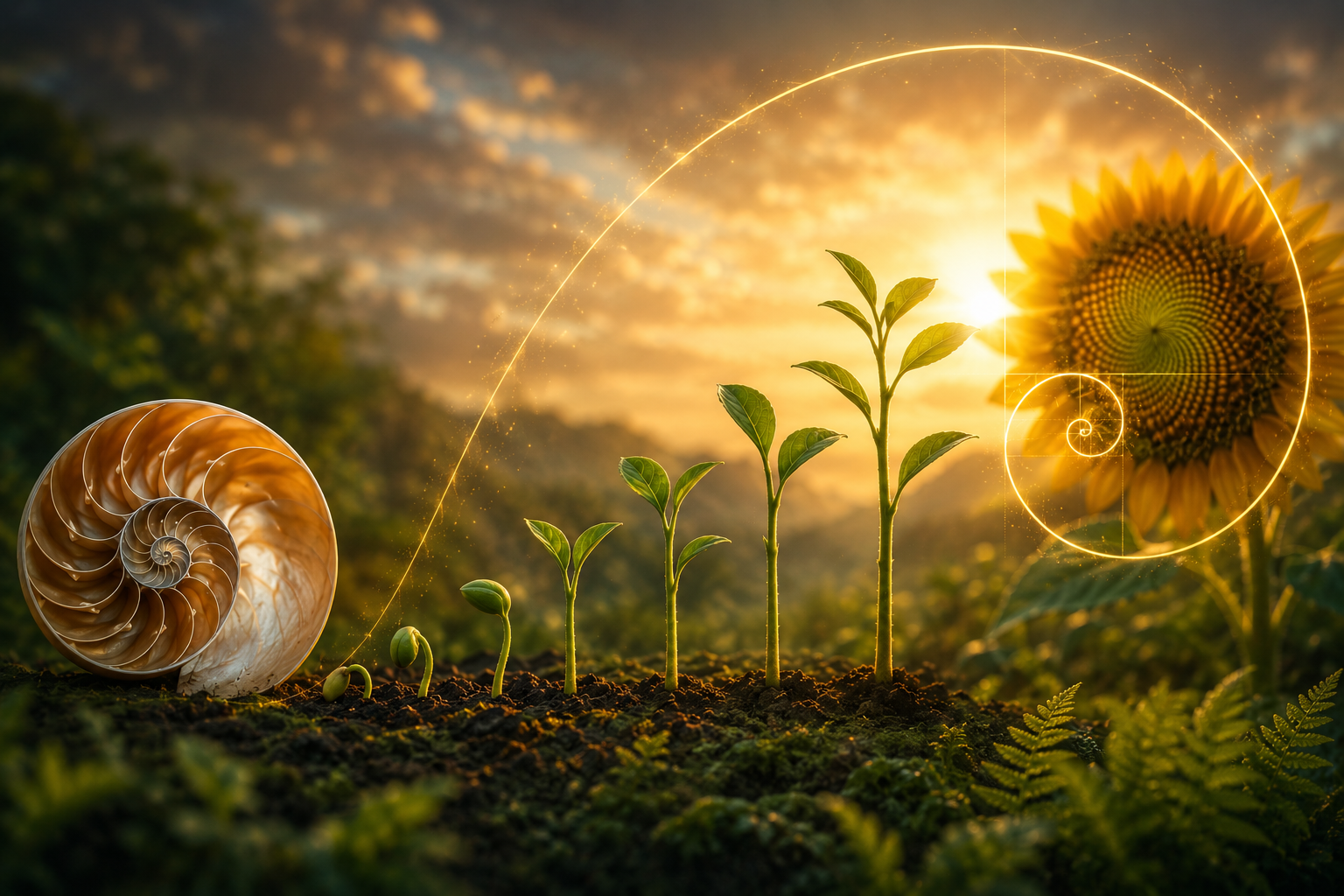
Fibonacci-related patterns do occur in some forms of plant growth, particularly in phyllotaxis—the arrangement of leaves, flowers, or other structures around a plant stem.
Research into phyllotaxis has explored the mathematical patterns of these arrangements as well as the biological mechanisms behind them.
One of the most familiar relationships is the golden angle, approximately 137.5 degrees. This angle appears frequently in spiral arrangements of plant organs and has been studied at the intersection of mathematics, physics, and plant biology.
Look closely at a sunflower and mathematics begins to become visible in the living world.
What is especially beautiful, though, is that nature does not simply reproduce one rigid shape. Plants develop through complex biological processes, and different species can produce different arrangements. Researchers continue to investigate how biochemical and physical mechanisms contribute to the patterns we see.
A pattern can create coherence without taking away individuality.
Nature can share an underlying rhythm while every flower, branch, and living form remains distinctly its own.
The Golden Spiral
Phi also gives us a beautiful geometric form: the Golden Spiral.
Imagine a rectangle built from the proportions of phi. Divide it again according to the same relationship, then continue inward. A sequence of smaller rectangles appears, and a curve drawn through them creates a spiral that expands continuously from its center.
The form feels organic because every new section remains related to what came before it.
It is not simply repetition.
It is relationship carried forward.
That image may be one reason phi has become such a powerful symbol in art and design. Its proportions offer a way to explore how individual elements can remain connected while a larger form unfolds. The Golden Ratio has been discussed in connection with architecture and visual composition throughout mathematical history.
The Shape of Growth
This is where phi becomes more than an elegant mathematical idea.
The Fibonacci sequence begins with very little: 0, 1, 1. Then each new number grows from what came before it. The pattern expands, but it does not abandon its origin.
There is something recognizable in that.
A thought becomes a choice. A choice becomes a practice. A practice becomes a pattern. Over time, those patterns begin to shape a life.
The spiral offers a similar image. It moves outward while remaining connected to its center.
Perhaps growth is not only about becoming larger. Perhaps it is about expanding without losing relationship.
A creative project can develop this way. So can a business, a craft, a relationship, or a personal practice.
Growth does not have to mean constant acceleration.
Sometimes it means allowing each new layer to emerge from what has already been learned.
Phi and Consciousness
Across spiritual traditions, philosophy, and contemplative thought, phi has often been interpreted as a symbol of harmony, creation, unity, and an underlying order within existence.
We can hold those meanings as invitations rather than declarations.
Phi does not need to be proven as a hidden code of consciousness for the symbolism to be meaningful. It can simply become a lens through which we contemplate relationship: the space between effort and rest, individuality and belonging, expansion and integration, movement and stillness.
Perhaps this is where mathematics and contemplation quietly meet.
Not in proving that the universe has hidden a message inside a number, but in allowing a pattern to change the way we pay attention.
Living With Proportion
What happens when the idea of proportion moves beyond geometry and into everyday life?
A creative life can make room for both expression and silence. A growing enterprise can leave space for reflection rather than measuring every season only by expansion. A daily ritual can become richer through consistency and attention rather than constant novelty.
The question is not how to make life conform perfectly to a mathematical proportion.
It is simply:
Where might greater harmony be possible?
Where could work and restoration support one another? Where might expansion need integration? Where could simplifying one part of life create room for something more meaningful to grow?
Phi can become a quiet metaphor for proportion rather than perfection.
The invitation is not to force life into a mathematical shape. It is to notice the relationships already shaping it.
The Beauty of the Pattern
Perhaps that is why phi has held human attention for so long. It begins as mathematics, but it leads us toward spirals and flowers, architecture and art, growth and proportion.
What makes these patterns especially beautiful is that harmony does not require sameness. Nature can follow an underlying rhythm while every flower, branch, and living form remains distinctly its own.
A pattern can create coherence without taking away individuality.
Look again at the spiral.
It continues unfolding from the center, carrying the relationship of what came before while creating something new with every turn.
Perhaps that is something worth remembering.
We do not have to choose between belonging and becoming.
There can be harmony in the pattern, and freedom in the expression.
Phi may be a number, but perhaps its deeper invitation is to notice the beauty of becoming uniquely ourselves within the larger pattern of life.
Sources & Educational Note
- Encyclopedia of Mathematics — “Golden ratio”
- Wolfram MathWorld — “Golden Ratio”
- O'Connor, J. J., & Robertson, E. F. — MacTutor History of Mathematics, “The Golden Ratio”
- Kuhlemeier, C. (2007) — “Phyllotaxis”
- Pennybacker, M. F., Shipman, P. D., & Newell, A. C. (2015) — “Phyllotaxis: Some progress, but a story far from over.”
Mathematical definition, history, and geometric applications.
Mathematical relationship between phi and successive Fibonacci ratios.
Historical development of the Golden Ratio, Fibonacci connection, and cultural interpretations.
Trends in Plant Science, 12(4), 143–150. Research on plant pattern formation and the golden angle.
Physica D: Nonlinear Phenomena, 306, 48–81. Review of mathematical, biochemical, and biomechanical explanations for plant pattern formation.
The Sacred Sound Vault holds the frequency sessions behind these notes.
Start 7-Day Free Trial