


How to Create a Sound Bath at Home That Actually Sounds Good
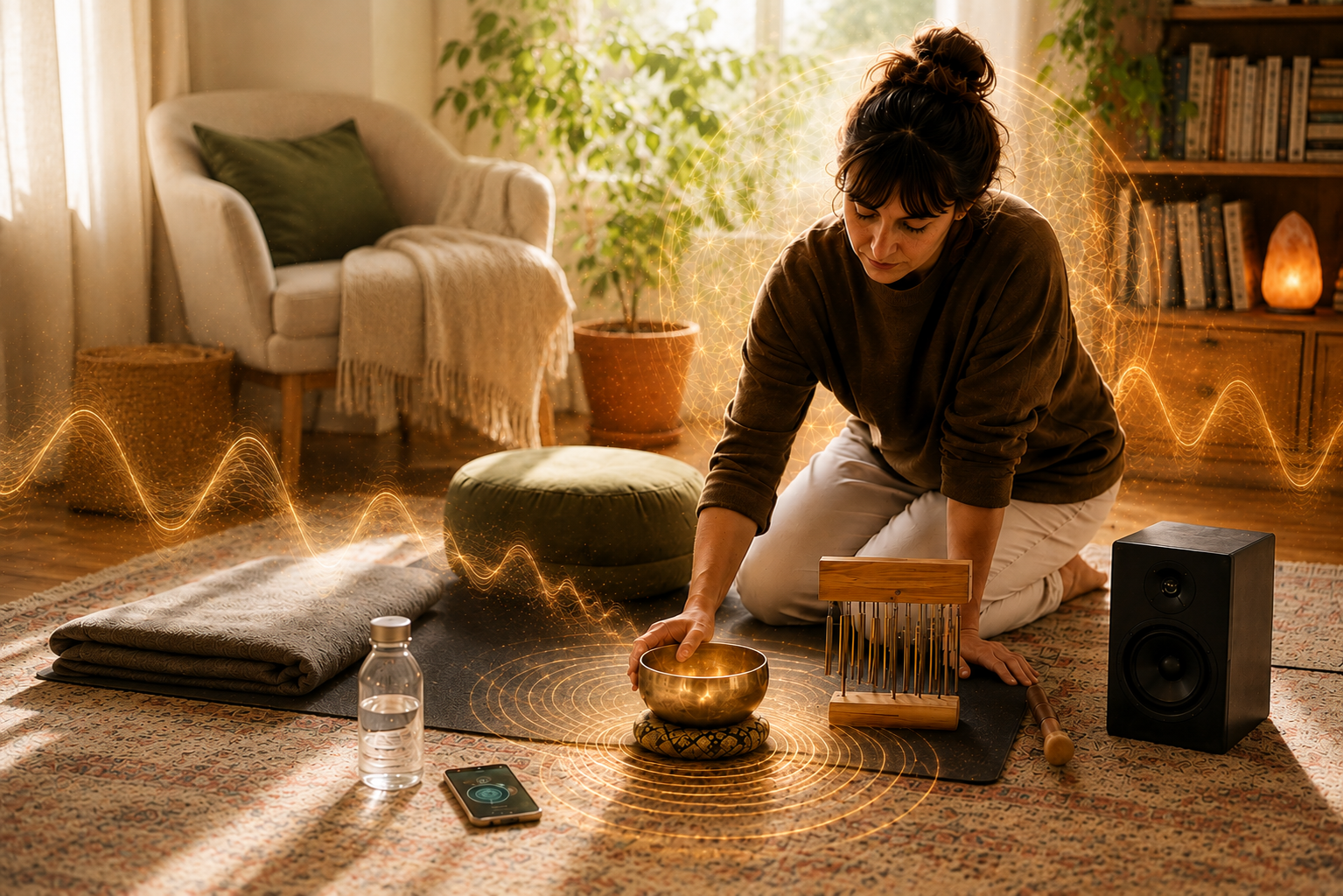
You do not need a room full of singing bowls to create a beautiful sound bath at home. Start with one sound, listen to what the room does with it, and discover how much more spacious the experience can become when you stop trying to fill every silence.
You do not need a room filled with singing bowls, a large gong, or a dedicated meditation space to create a sound bath at home.
A comfortable place to listen, one sound source you enjoy, and a little attention to the room can be enough.
The surprising part is that creating a beautiful listening experience often has less to do with adding more sound and more to do with learning when to leave it alone.
Strike a bowl and listen beyond its first clear tone. As it rings, other tones emerge. The sound meets the room and slowly changes. Eventually, it becomes so quiet that you cannot quite tell where the bowl ended and the room began.
That fading sound is part of the experience.
A satisfying home sound bath begins with learning to hear it.
Begin With the Room
Before choosing music or arranging instruments, listen to the space itself.
Clap once.
Does the sound disappear quickly, or does a small echo remain?
Now notice what is already there: ventilation, traffic, an appliance humming, voices elsewhere in the house.
Your room is part of the sound bath before you play the first note.
Hard surfaces such as windows, bare floors, and walls reflect sound. Rugs, curtains, books, and upholstered furniture can soften some of those reflections.
You do not need to turn the room into a recording studio. Moving your chair, closing a door, adding a rug, or shifting a speaker may change the experience considerably.
Every room already has a voice. Before adding another sound, listen for the one that is already there.
Start With One Sound
For a first sound bath, simplicity gives you room to listen.
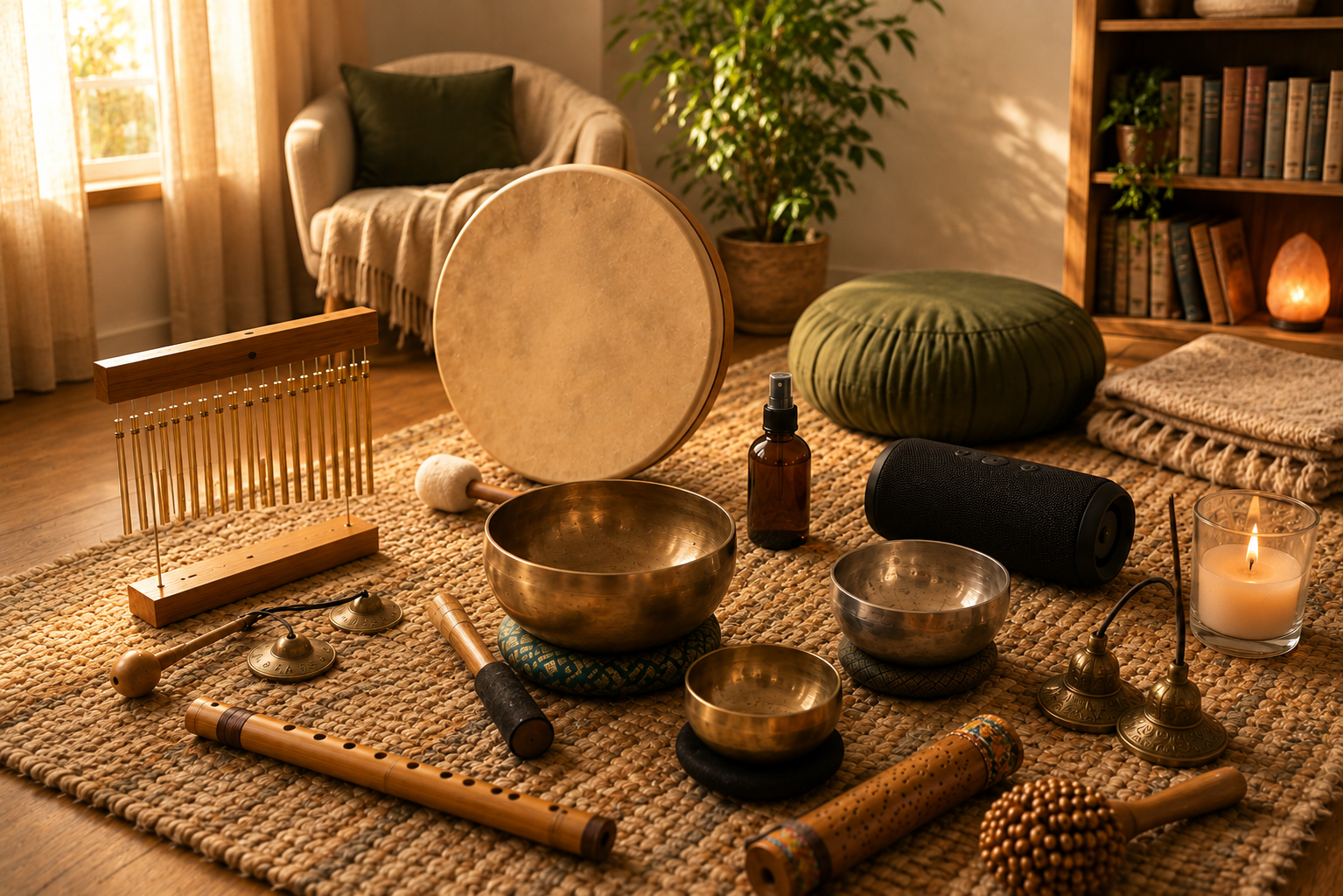
A recording you already enjoy may be enough. If you would rather create the sounds yourself, begin with one familiar instrument: perhaps a singing bowl, a gentle chime, a softly played frame drum, or your own voice.
Then become curious about it.
How softly can the sound begin?
How long does it remain in the room?
What happens as it fades?
Does it sound different when you play it from another place?
One instrument can contain more variety than we first notice. A singing bowl, for example, has an initial strike, a sustained tone, changing overtones, and a long decay as its vibrations gradually lose energy.
You do not have to fill that decay with another sound.
Sometimes the most interesting thing you can do is wait.
Give Your Sound Bath a Simple Shape
For a first session, about 20 minutes can be plenty.
Begin with a minute or two of quiet. Settle into your mat, cushion, bed, or chair and notice the room.
Then introduce sound gradually.
Through the middle of the session, allow a little contrast: deeper and brighter tones, sustained and brief sounds, repetition and change.
As you approach the end, begin taking things away.
A simple arc might look like this:
Arrive → Open → Explore → Simplify → Silence → Return
You do not need to follow the timing perfectly. The sequence simply gives the experience somewhere to go.
If You Are Using a Recording
A thoughtfully made recording may be the easiest way to create a sound bath at home when you want to receive the experience rather than perform it.
Place your speaker some distance from your head and listen from the position where you plan to rest.
Test the strongest section first.
Does anything rattle?
Does the bass become overwhelming?
Does the sound feel harsh?
Before changing the volume, try moving either yourself or the speaker. Low frequencies interact strongly with room dimensions and boundaries, so a small change in position can sometimes produce a surprisingly different listening experience.
Use the equipment you have where it sounds comfortable and clean. Immersive does not have to mean loud.
Let Silence Belong
One of the easiest mistakes in a sound bath is feeling responsible for every second.
A bowl fades, so another is struck. A chime follows. Then another sound fills the opening.
Soon there is plenty of sound but very little room to listen.
Try allowing a tone to disappear completely.
Then wait.
At first, the silence may seem empty. Soon other details begin to appear: a distant car, air moving through the room, the house settling, perhaps your own breathing.
Those sounds were there all along.
You simply notice them now.
Silence is not the absence of the sound bath.
It is one of its textures.
The Part You Cannot Buy
Better equipment can be enjoyable. More instruments can offer new colors. A beautiful room can make listening easier.
But none of them replaces attention.
The quality of a home sound bath often comes from something much simpler: listening closely enough to notice when a sound has already given you everything it has to offer.
Begin with one sound.
Let it bloom.
Let it change.
Let it disappear.
Then notice what remains.
Sometimes creating a richer listening experience begins not by adding another sound, but by discovering how much was already there.
Sources & Educational Note
- World Health Organization: Safe Listening
- MIT OpenCourseWare: Room Acoustics and Reverberation
- Choi and colleagues: Therapeutic Effects of Singing Bowls—A Systematic Review (2025)
- Cleveland Clinic: What Is a Sound Bath?
This article is intended for general education and creative listening. Bio Alquemie sound and frequency experiences are offered for listening, reflection, creativity, ritual, and general wellness. They are not intended to diagnose, treat, cure, or prevent medical or mental-health conditions.
Research into singing-bowl and related sound practices continues to develop, and individual experiences can vary.
The Sacred Sound Vault holds the frequency sessions behind these notes.
Start 7-Day Free Trial