


How Do Neural Pathways Form? The Brain, Repetition, and Neuroplasticity

How do neural pathways form? Explore neuroplasticity, repetition, learning, and the quiet ways repeated thoughts and experiences can shape the paths our brains become familiar with.
Walk through tall grass for the first time and there is no path.
The grass bends beneath your feet, then slowly rises again. Walk the same way tomorrow and the journey becomes a little easier. After enough journeys, a trail begins to appear.
Your brain has something remarkably similar.
Every thought, movement, perception, memory, and learned skill depends on networks of communicating nerve cells. Those networks are not fixed in place. With experience and learning, connections between neurons can strengthen, weaken, appear, or disappear.
This capacity for the brain to change is called neuroplasticity.
And it means something quietly hopeful:
The brain can learn.
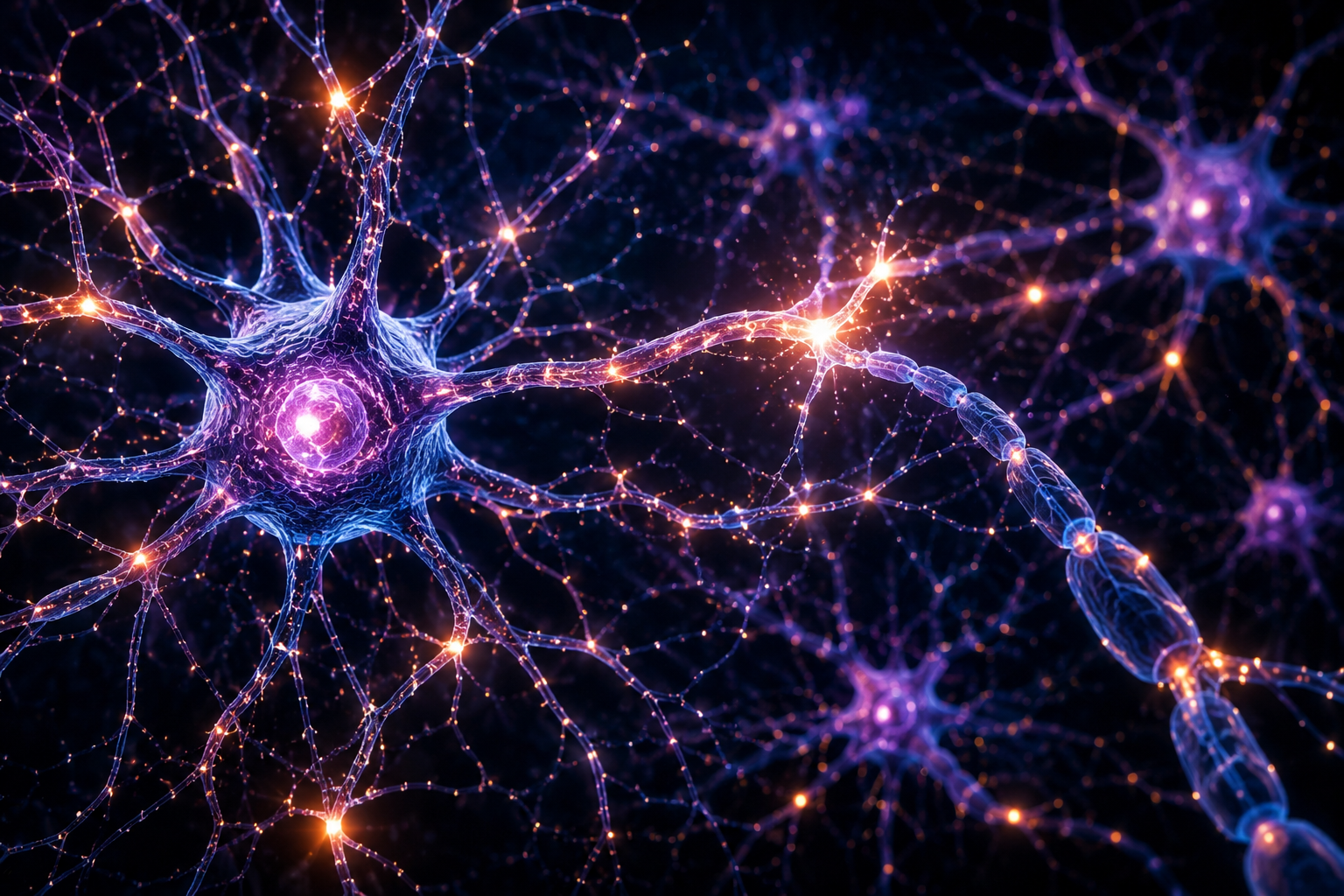
What Is a Neural Pathway?
A neural pathway is a connected pattern of neurons and synapses that participates in a particular process.
Neurons communicate with one another at junctions called synapses. When certain groups of neurons are repeatedly activated together, the connections within those networks can become more effective. This is one of the ways the nervous system adapts to experience and learning.
A simplified way to imagine the process is:
Experience → neural activity → repetition → changing connections → easier future activation
The biology is considerably more complicated than that sequence suggests. The important idea is that the brain is continually responding to what we experience and practice.
Learning changes us.
Not metaphorically.
Biologically.
“Neurons That Fire Together, Wire Together”
You may have heard the phrase “neurons that fire together, wire together.”
It is a simple expression of an idea associated with Hebbian learning, named after psychologist and neuroscientist Donald Hebb. The basic principle is that when patterns of neural activity occur together repeatedly, connections between participating neurons can become stronger.
The phrase is useful, as long as we remember that the real brain is more complicated than the slogan.
Neurons do not simply decide to form permanent partnerships every time they are active. Plasticity is influenced by timing, chemical signals, the surrounding network, attention, experience, and many other biological processes.
Still, the underlying insight has remained important to neuroscience:
What we repeatedly practice can influence what the brain becomes better prepared to do.
Practice Is Larger Than Learning a Skill
We often think of brain training in terms of obvious skills—learning piano, speaking a new language, practicing tennis, or memorizing a route home.
And these are excellent examples of neuroplasticity.
But learning is not limited to physical skills.
The brain also responds to repeated patterns of attention, experience, emotion, and behavior. Research on adult neuroplasticity shows that experience and learning can be associated with changes in neural structure and function across the lifespan.
This is where the idea becomes much more personal.
Suppose someone repeatedly encounters a difficult situation and responds with:
Something is going to go wrong.
That sentence does not carve itself into the brain like words etched in stone.
But the larger pattern may involve attention, emotion, physiological arousal, interpretation, and behavior. When similar experiences repeatedly activate similar networks, that response can become increasingly familiar.
The same principle can work in another direction.
A person might begin practicing:
Pause. Breathe. Look again. I can work through this.
That does not instantly erase the old response. It introduces another pattern. And with practice, that pattern can become more familiar too.
The Brain Learns What We Rehearse
Imagine returning again and again to the same trail through the grass.
Eventually you do not have to think carefully about where to place every foot.
The path is easier to follow.
Our brains can develop similar efficiencies through learning. Repeated behaviors and mental processes can become increasingly familiar and accessible, which is one reason practiced skills can eventually feel almost automatic.
This is also why habits can be difficult to change.
The old trail already exists. You know where it goes. Sometimes you follow it before you have consciously decided to.
That does not mean the pattern is permanent.
It means it has been practiced.
What About Negative Self-Talk?
This is where neuroplasticity meets something many people recognize immediately: the voice inside the mind.
I'm not good at this.
I'll probably mess it up.
People won't understand me.
I always do this.
When these thoughts recur, it can be tempting to imagine that negative sentences are literally being “wired into the brain.” That is too simple.
The more useful way to understand it is that repeated thoughts can become part of repeated patterns of attention, emotion, interpretation, and behavior.
The brain is learning from the whole experience. And the opposite is also possible. A different response can be practiced.
Let me slow down.
I don't know the outcome yet.
I can learn this.
What else might be true?
These thoughts are not magic spells. They are possible starting points for a different pattern of attention and action.
Familiar Does Not Mean True
There is another reason this matters.
The brain uses previous experience to help interpret what is happening now. What we have encountered before can influence what we notice, what we expect, and how we respond.
A familiar thought can therefore arrive very quickly. And because it is quick and familiar, it can feel true. But familiarity and truth are not the same thing. That small distinction can create a surprising amount of space.
You can notice:
I've had this thought many times.
without immediately deciding:
Therefore it must be true.
Awareness creates a pause. And a pause creates a possibility for something new to be practiced.
Neuroplasticity Does Not Mean Erasing the Old Path
This may be one of the most important things to understand.
Building a new neural pattern does not necessarily mean deleting an old one.
Learning can involve strengthening new connections, changing how networks interact, and making alternative responses more accessible. Existing patterns may still pop up, particularly under familiar conditions or stress.
Think again about the trail. The old path may still be there. You have simply made another path easier to find.
Sometimes you will still step onto the old one.
That is not failure.
It is information.
You can notice where the old trail leads, turn around, and practice another route.

What Makes a New Path Stronger?
Repetition matters, but repetition is not the only ingredient.
Learning is influenced by attention, experience, feedback, motivation, context, and the kind of practice being performed. Research suggests that the brain becomes better at what we practice, rather than improving every ability at the same time.
Simply repeating a sentence without attention or personal meaning is not the same as learning a new response through repeated experience.
A more complete process might look like this:
Notice → practice → experience → repeat → refine
Over time, the new response can become more familiar. Not because you forced your brain to believe something. Because you gave it something new to learn.
A Different Way to Think About Change
Perhaps we have sometimes imagined change as demolition. Tear down the old. Replace it with the new.
The brain may offer us a gentler metaphor.
Cultivation.
You notice where the grass is already worn down. You decide where you would rather walk. Then you begin taking that route, again and again.
Some days the old path will still be easier. Some days the new one will feel almost invisible. But with enough meaningful practice, another way forward can become easier to recognize.
That is one of the gifts of neuroplasticity. Not that we can control the brain completely. Not that every thought can be transformed through willpower.
But that experience matters.
Practice matters.
And the brain remains capable of learning.
The Path We Practice
Every day gives us countless small opportunities to rehearse something.
Attention.
Patience.
A familiar reaction.
A new response.
Curiosity.
Presence.
We do not get to choose every experience that arrives. But we often have some influence over how we respond. That is where the metaphor of the path becomes useful again.
The old road may still exist. But it does not have to be the only road you know how to take.
And this is where the next question naturally begins:
What happens when we deliberately practice a different way of responding?
That is where guided meditation, mental rehearsal, self-talk, imagery, and intentional attention become especially interesting.
We will explore that next.
Sources & Educational Note
- Neural Plasticity Across the Lifespan — Review of experience-dependent and Hebbian plasticity, including how repeated neural activity can strengthen connections.
- A Metaplasticity View of the Interaction Between Homeostatic and Hebbian Plasticity — Overview of Hebbian learning and the familiar “neurons that fire together, wire together” principle.
- Adult Neuroplasticity: More Than 40 Years of Research — Review of structural and functional changes associated with learning, experience, and other influences on the adult brain.
- Experience-Dependent Structural Synaptic Plasticity in the Mammalian Brain — Review of changes in synapses and neural structures associated with experience.
Educational Note: Neuroplasticity describes the brain's capacity to change with experience, learning, and other influences. It does not mean that thoughts can be consciously programmed into the brain at will, nor does it guarantee that a particular thought, meditation, or practice will produce a particular biological outcome. This article is for general education and is not medical or mental-health advice.
The Sacred Sound Vault holds the frequency sessions behind these notes.
Start 7-Day Free Trial