
528 Hz: The Love Frequency, the Miracle Tone, and the Meaning We Give Sound
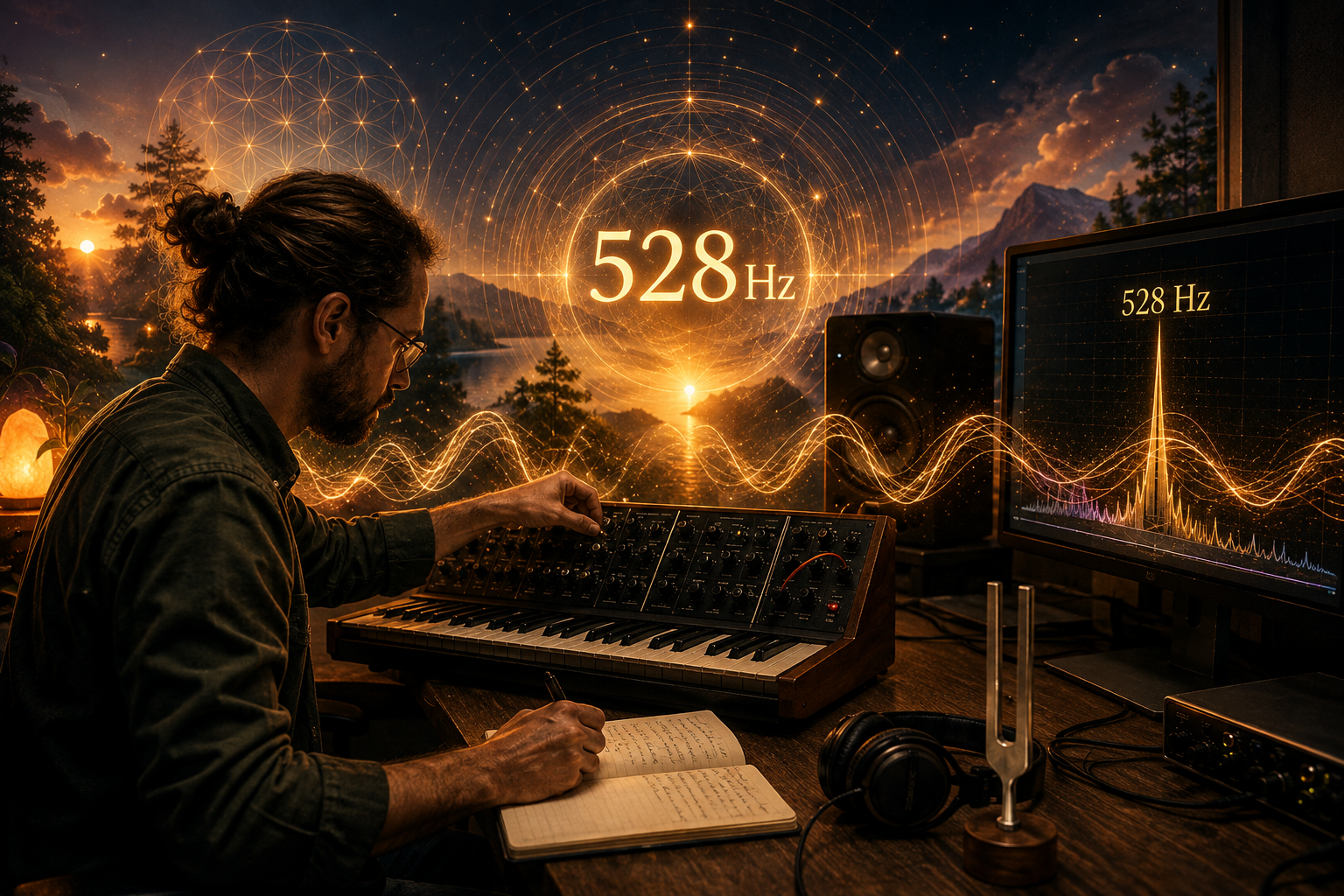
Why has 528 Hz become known as the Love Frequency and the Miracle Tone? Explore the history, symbolism, science, and personal meaning surrounding this intriguing sound—and discover what happens when you simply listen.
There are sounds that simply pass through a room.
And then there are sounds that seem to gather meaning around them.
528 Hz is one of those sounds.
You may have encountered it in meditation music, sound healing, Solfeggio recordings, or a quiet evening practice. It is often called the Love Frequency or the Miracle Tone, and for many people it has become associated with transformation, compassion, renewal, and inner peace.
But what is actually special about 528 Hz?
The answer depends partly on which lens you are using.
There is the mathematical frequency: a sound wave cycling 528 times each second. There is the musical and historical story surrounding the Solfeggio tradition. There are modern spiritual interpretations that connect the tone with the heart, sacred geometry, and personal transformation. And there is a growing body of research exploring how music at different frequencies may interact with human physiology and experience.
Perhaps the most interesting part is that these perspectives can be explored without requiring them all to answer the same question.
What Is 528 Hz?
In the simplest sense, 528 Hz is an audible frequency. A pure 528 Hz tone completes 528 cycles every second.
The number itself is precise.
What people experience through music built around that frequency is much richer. A meditation recording may contain many frequencies at once, along with instruments, harmonics, rhythm, voice, silence, and the character of the recording itself.
That means the experience of 528 Hz music is not necessarily the experience of listening to one pure tone.
This distinction is useful because it allows us to appreciate both the mathematics and the music.
A frequency gives us a point of reference.
The composition gives us the experience.
Why Is 528 Hz Called the “Love Frequency”?
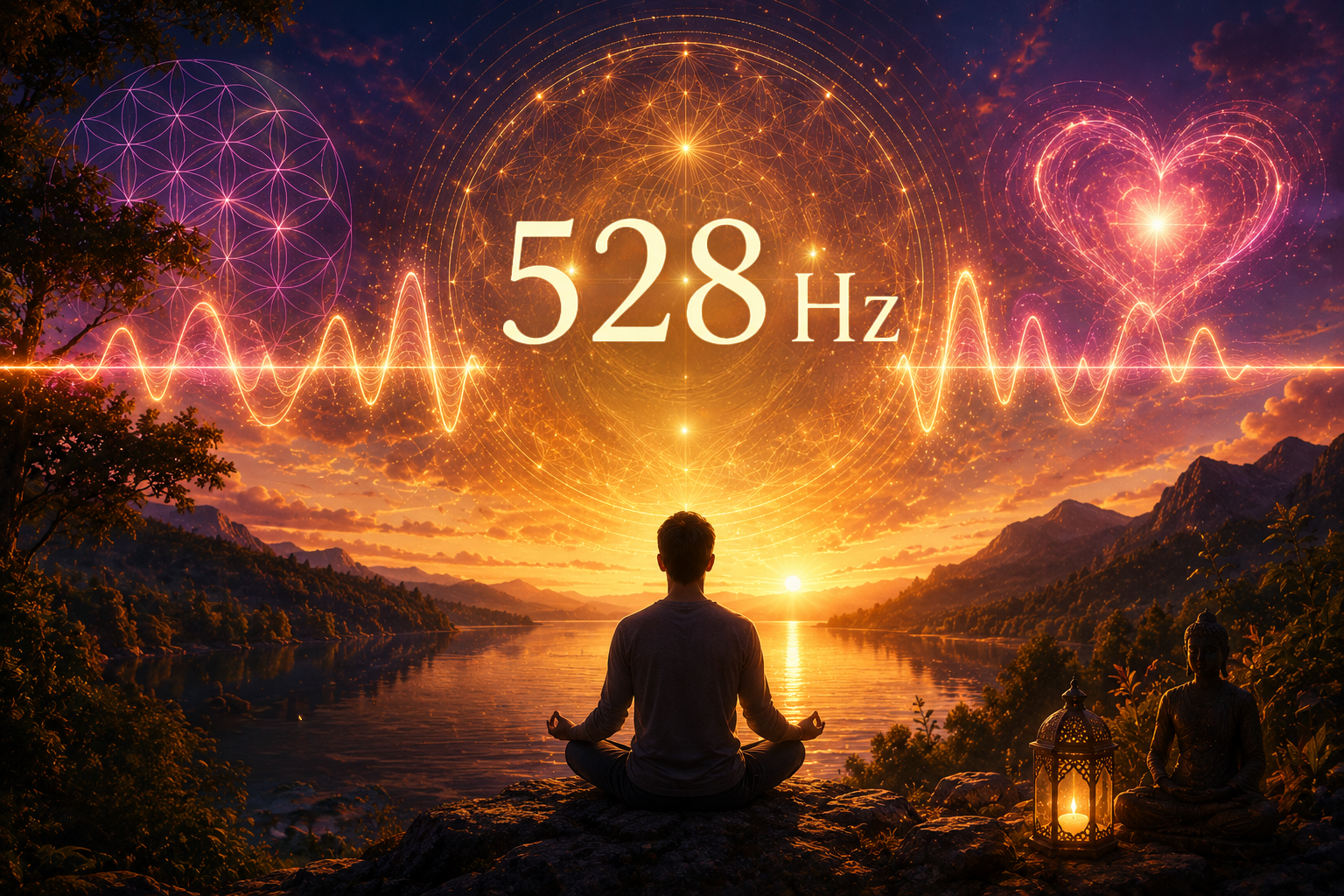
Within modern sound-healing and spiritual traditions, 528 Hz is often described as the Love Frequency. It is also associated with the Miracle Tone, transformation, healing, compassion, restoration, and renewal.
For some practitioners, those meanings connect the tone with the heart or solar plexus chakras. Others associate it with emotional clearing, inner harmony, sacred geometry, or a sense of connection to something larger than the individual self.
These interpretations are part of a living spiritual culture.
You do not have to adopt every interpretation for the symbolism to be interesting.
A sound can become connected with an intention.
You hear 528 Hz and remember that this is the sound you play when you want to slow down. You return to it during meditation. You associate it with compassion, forgiveness, renewal, or a new beginning.
Over time, the frequency can become part of a ritual.
And ritual has a way of giving sound memory.
The Solfeggio Connection
528 Hz is commonly described as Mi within the modern Solfeggio frequency tradition.
Modern spiritual literature often connects the tone with the Latin phrase mira gestorum, commonly translated as “miracles,” and this association helped shape the language of the Miracle Tone.
The historical story is more complicated than the modern version sometimes suggests. Absolute frequencies such as 528 Hz were not standardized in the way they are today, so it is more accurate to understand the modern Solfeggio story as a tradition that has been interpreted and developed over time rather than imagining an ancient world using modern frequency measurements.
That does not make the tradition less fascinating.
It simply gives us a more interesting place from which to explore it.
Traditions evolve.
Meanings gather.
A number becomes a symbol, and eventually the symbol becomes part of how people experience the sound.
What Is Science Exploring?
The scientific story is beginning in a different place.
Researchers have explored whether music at 528 Hz may be associated with measurable changes in stress, mood, or physiological markers. A 2018 study involving nine healthy adults compared 528 Hz music with 440 Hz music and measured salivary biomarkers, autonomic nervous-system activity, and mood. (CiNii Research)
More recently, a randomized controlled study involving 162 university students compared 528 Hz music, 432 Hz music, and no music during a period of exam-related stress. The 528 Hz group showed higher salivary BDNF and CREB levels (proteins involved in processes related to learning, memory, and cellular adaptation) than the control group, although there was no significant difference between groups on the immediate Stroop cognitive-performance measure. (PubMed)
These studies are interesting because they give us something to explore.
Music is complex. The listener is complex. The setting, expectation, musical composition, duration, and many other details can shape the experience.
And that is perhaps where the scientific and experiential perspectives can sit comfortably beside one another.
Science can measure certain responses.
A listener can notice meaning.
What About the Stories of DNA, Water, and Sacred Geometry?
This is where the world of 528 Hz becomes especially imaginative.
Some modern spiritual traditions describe the frequency as connected with DNA repair, water restructuring, sacred geometry, the Merkaba, planetary frequencies, or a deeper mathematical architecture of creation.
These ideas form part of the wider mythology and symbolic language surrounding 528 Hz.
They can be intriguing to contemplate.
These ideas belong to a spiritual way of understanding sound, while science approaches the same questions through what can be measured. The two perspectives can sit beside one another, leaving room for both curiosity and wonder.
A person can hear 528 Hz and experience it as sacred, meaningful, or beautiful without needing the sound to carry a scientifically proven message about every cell in the body.
There is room for mystery.
There is also room for precision.
What Might 528 Hz Mean to You?
Perhaps the most interesting question is not what 528 Hz is supposed to do, but what happens when you listen.
You might hear warmth or spaciousness. It might become part of a meditation, a creative ritual, or a quiet moment at the end of the day. You might feel something immediately, or nothing remarkable at all. Either way, listening gives you something to notice.
Try a pure 528 Hz tone, then listen to music built around the frequency. Notice how each experience feels. Notice what memories, intentions, or emotions arise, and whether the sound changes the quality of your attention.
A frequency can carry history, symbolism, mathematics, music, and memory—and still remain simply a sound moving through the air.
Perhaps its meaning is not something we discover once and keep forever. It can unfold through relationship: between sound and memory, vibration and attention, tradition and experience.
528 Hz can be a number, a musical frequency, a spiritual symbol, or simply a doorway into presence.
There is much more to explore—from the history of the Solfeggio frequencies to the emerging research around sound and human experience. The articles to come will open those doors more deeply, allowing the larger picture to unfold over time.
For now, listen. Let the sound be the beginning of the question.
Sources & Educational Note
- Akimoto, K., Hu, A., Yamaguchi, T., & Kobayashi, H. (2018). Effect of 528 Hz Music on the Endocrine System and Autonomic Nervous System.
- Bozok, D. Ö. et al. (2026). Acute Music-Frequency Exposure Modulates Salivary Stress and Neurotrophic Markers in Young Adults: A Randomized Controlled Trial.
This article is provided for general educational and contemplative purposes. Bio Alquemie’s frequency-based audio experiences are created for listening, reflection, creativity, ritual, and general wellness. They are not intended to diagnose, treat, cure, or prevent a medical or mental-health condition.
The Sacred Sound Vault holds the frequency sessions behind these notes.
Start 7-Day Free Trial