
432 Hz vs. 440 Hz: Can You Hear the Difference?
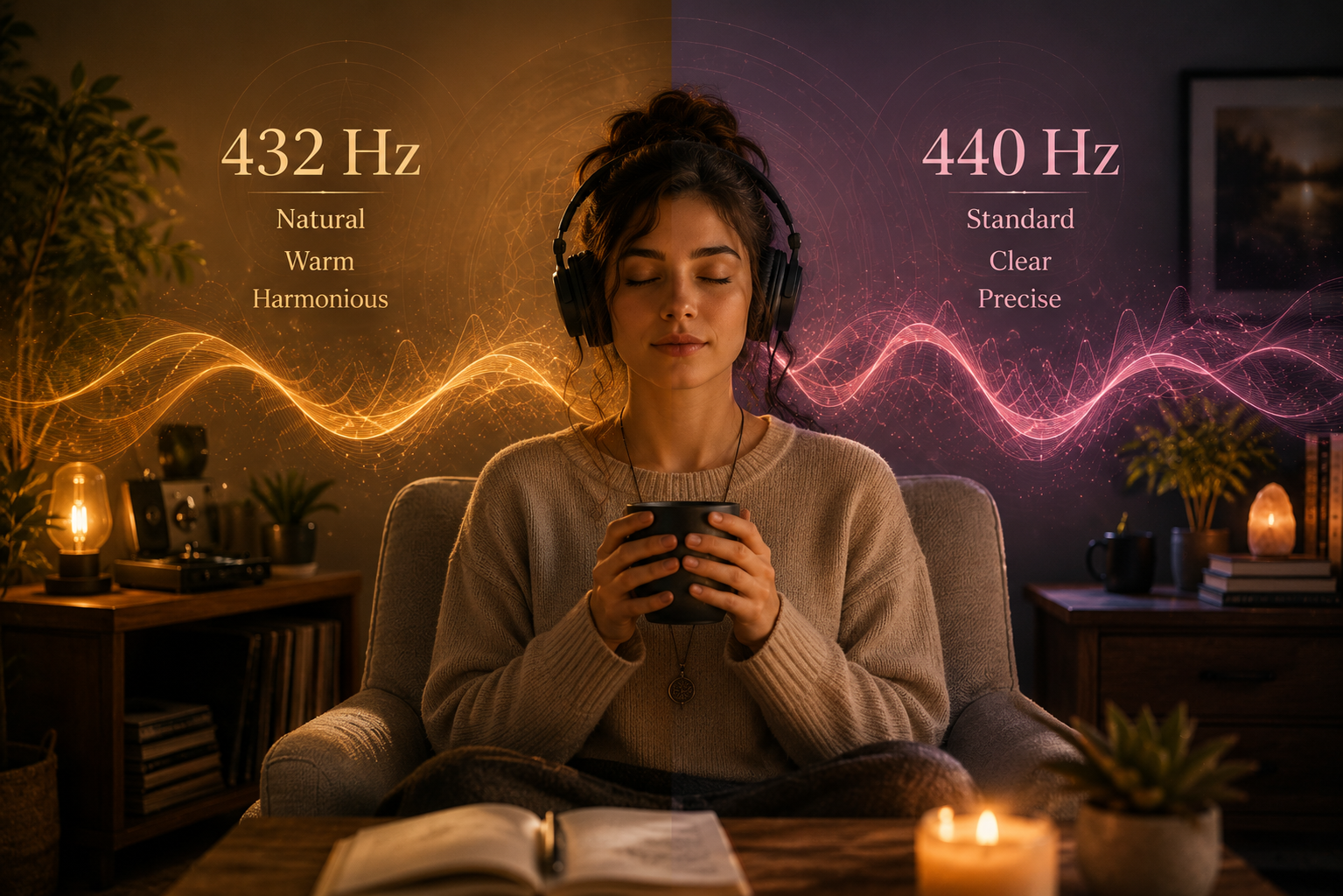
Two versions of the same music. One tuned to 432 Hz, the other to 440 Hz. Can you really hear the difference—or does knowing the numbers change what you expect to hear? Listen closely and discover what your ears reveal.
You hear a familiar piece of music.
Then you hear it again, just slightly lower.
Something feels different.
But can you actually hear the difference—or does knowing that one version is labeled 432 Hz change what you expect to hear?
That is where this question becomes interesting.
Music tuned to A = 432 Hz is slightly lower than the same music tuned to A = 440 Hz. The difference is measurable: retuning the whole performance lowers every pitch by about 31.8 cents, or roughly one-third of a semitone. Some listeners can detect the difference. Some prefer the lower tuning. Others prefer 440 Hz.
The numbers are clear.
The experience is where the curiosity begins.
What Do 432 Hz and 440 Hz Actually Mean?
When musicians talk about 432 Hz or 440 Hz tuning, they are usually talking about the reference used to tune A4, the A above middle C.
Today, A4 = 440 Hz is the standard reference used for much of modern music. It gives musicians, instrument makers, and ensembles a common point from which to tune.
With A = 432 Hz, the reference is lowered slightly. The musical intervals remain in the same relationship, but the entire performance sits a little lower.
A piece described as “432 Hz music” also does not mean that the recording contains only one 432 Hz tone.
It means the music has been tuned using that reference.
That small distinction opens a much larger listening experience.
So, Can You Hear It?
Many listeners can detect the difference between 432 Hz and 440 Hz in a careful side-by-side comparison.
But hearing a difference and preferring a difference are two separate experiences.
So let's set the labels aside for a moment.
Listen first. Decide later.
A lower-tuned version may strike someone as warmer, darker, softer, or less tense. Another listener may hear the same version as less familiar and prefer the brightness of 440 Hz. Musical material, playback equipment, hearing, training, and expectations can all influence what someone notices.
And this gives us a much more interesting question than “Which tuning is better?”
What do you hear when you do not know which one you are hearing?
Try Listening Without Knowing
A simple blind comparison can turn the question into an experience.
Take the same recording and create two versions: one tuned to A = 432 Hz, the other to A = 440 Hz. Keep the tempo and everything else as consistent as possible, match the loudness, and hide the labels.
Then listen.
Which version do you think is A?
Which is B?
And separately, which one do you prefer?
Those are two different questions.
If you can consistently identify the versions, you may be hearing the tuning difference under those conditions. If you simply prefer one, that tells you something different—and equally useful—about your listening experience.
You do not need to make one result more important than the other.
Sometimes discovering what you prefer is enough.
A Small Number With a Surprisingly Large Effect
The difference between 432 Hz and 440 Hz is only eight hertz at A4, yet lowering the reference shifts the entire performance.
Think of a painting moved slightly downward on a wall. Nothing about the picture has been rearranged. Every relationship remains intact. But the position has changed.
Music behaves similarly here.
The intervals remain proportional, but the whole musical landscape sits slightly lower.
That is why 432 Hz and 440 Hz are not two different musical systems. They are two reference points for tuning the same system.
Eight hertz does not look like much on a page.
But music is not experienced on a page.
You hear it. You feel its character. And sometimes, a very small change is enough to make a familiar piece suddenly sound unfamiliar.
A Tone Is Not a Tuning System
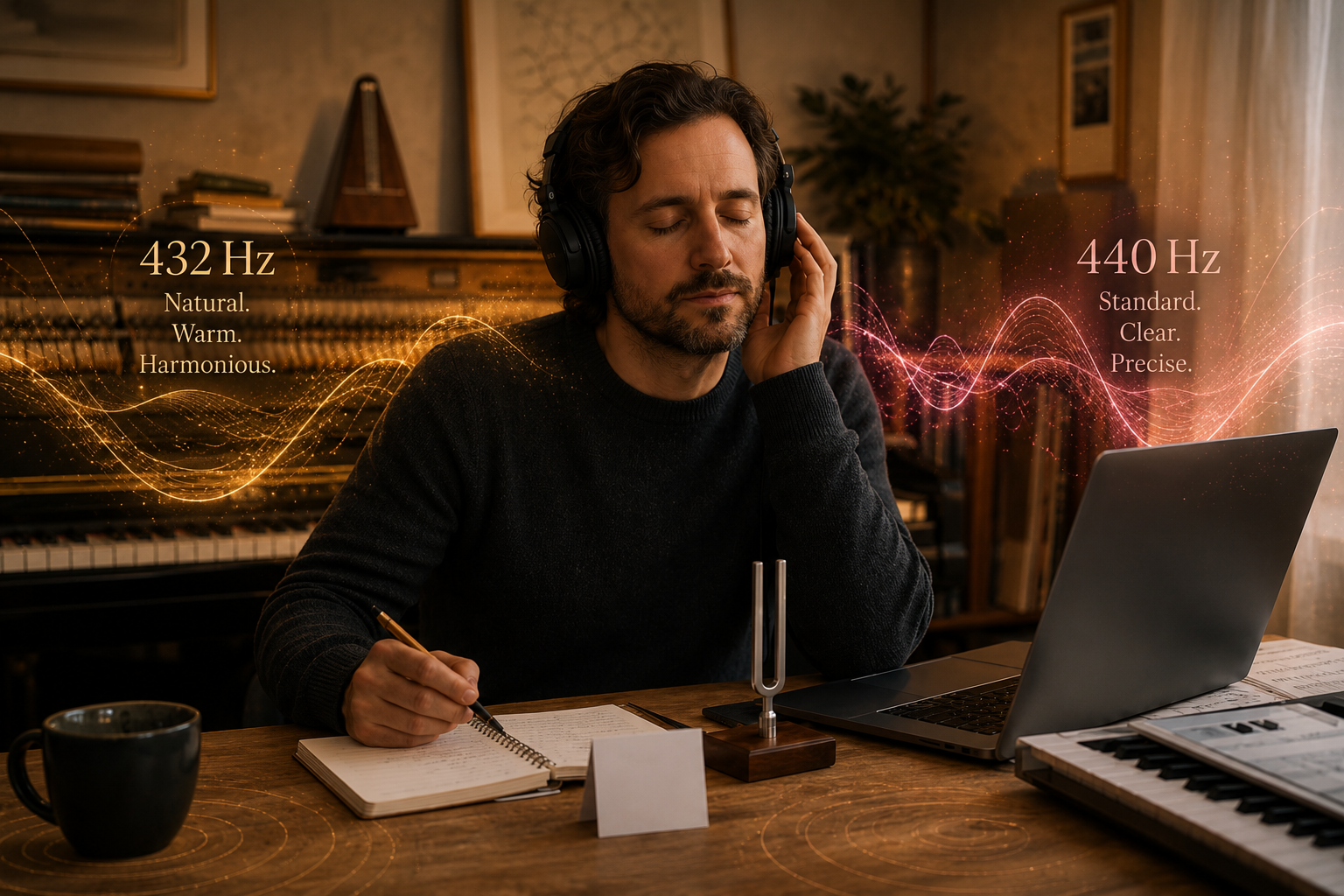
A number can sound more mysterious than it really is. “432 Hz” might make you imagine a single special tone, but music is never that simple.
A pure 432 Hz tone is one simple sinusoidal sound wave.
Music tuned to A = 432 Hz is something entirely different. It contains melodies, changing pitches, harmonics, transients, voices, instruments, and many other frequencies.
A recording can also contain a 432 Hz tone inside a conventionally tuned piece, or simply carry “432 Hz” in its title without making clear what the number refers to.
So when you encounter a frequency label, it is worth asking:
What role does the frequency actually play in this recording?
A number becomes much more useful once you know what it is describing.
Why Did 440 Hz Become the Standard?
So why 440?
Not because someone discovered that 440 Hz was the most beautiful number.
Musicians simply needed a shared reference.
There was a time when there was no single global concert-pitch reference. Different places, ensembles, instruments, and historical periods used different tuning standards. As international performance and music production expanded, a shared reference became increasingly practical.
The 440 Hz standard helped musicians and instrument makers coordinate across those differences.
That does not mean 440 Hz became the standard because it was declared the most beautiful tuning.
Standardization solves a coordination problem.
It does not settle a matter of taste.
Musicians still use other reference pitches for historical performance, particular instruments, vocal considerations, or artistic preference.
What Is the Research Exploring?
Researchers have begun asking whether the difference between 432 Hz and 440 Hz might be associated with changes beyond pitch perception.
Small studies have explored subjective experience as well as selected physiological measures. For example, a 2019 double-blind crossover pilot study involving 33 healthy adults reported differences in several measures after brief exposure to music tuned to 432 Hz versus 440 Hz. A later randomized pilot study examined 432 Hz and 440 Hz music in emergency nurses during work breaks.
These findings are interesting because they give us something to investigate, not a final answer.
And perhaps that is where this question becomes most interesting: what can careful listening tell us that a label cannot?
Different studies use different music, listening periods, participants, comparison conditions, and outcomes. Larger and more consistent research would help clarify how much of any observed effect comes from the tuning itself and how much may involve preference, expectation, musical character, or the listening context.
There is something refreshing about leaving a good question open.
Is 432 Hz More “Natural”?
This depends on what we mean by natural.
All frequencies are part of the greater field of vibration that exists throughout the Universe.
Some traditions experience 432 Hz as especially harmonious or natural, and that personal and spiritual meaning can remain part of the listening experience. But “natural” can also describe an experience.
A listener may hear 432 Hz as softer or more comfortable. Someone else may associate it with a particular musical tradition or personal ritual.
That meaning is real as an experience, even though it answers a different question from the physics.
Perhaps that distinction is worth holding gently.
Not everything meaningful needs to be measured in the same way.
Which Tuning Should You Use?
There is no need for 432 Hz and 440 Hz to become opposing camps.
Choose 432 Hz if you prefer its lower musical character, if it suits your instrument or voice, or simply because you enjoy listening to it.
Choose 440 Hz when you want to work easily with standard tuning, other musicians, existing recordings, or because that sound feels right to you.
And if you are curious, listen to both without knowing which is which.
The blind test can tell you whether you can distinguish them under those conditions. Your preference can tell you which one you enjoy.
Neither has to tell you what you are supposed to hear.
Listen for Yourself
Perhaps that is the most interesting part of the entire question.
A number can tell us exactly how a piece was tuned. It cannot tell us whether the music will feel warm, spacious, familiar, moving, or quietly right to you.
That is discovered through listening.
Try the comparison.
Close your eyes.
Let the labels disappear.
Then notice what remains when all you have is the music.
Sometimes the most interesting thing about a frequency is not the number itself, but what we discover when we stop looking at the number and listen.
Sources & Educational Note
- ISO 16:1975 — Standard Musical Pitch
- NIST — A440 Standard Pitch
- Calamassi & Pomponi — 440 Hz Versus 432 Hz: Double-Blind Crossover Pilot Study
- Music at 440 Hz Versus 432 Hz in Emergency Nurses — Randomized Pilot Study
- Associated Press — The 432 Hz Trend and the History of Concert Pitch
This article is provided for general educational purposes. Bio Alquemie’s audio experiences are offered for listening, reflection, creativity, and general wellness, not diagnosis or treatment.
The Sacred Sound Vault holds the frequency sessions behind these notes.
Start 7-Day Free Trial